Most San Diego homeowners who move from a city neighborhood to a property with a septic system feel a little uneasy at first. You flush a toilet and wonder what happens next. The good news: it’s a straightforward process, and once you understand it, the mystery goes away fast.
The 30-second version
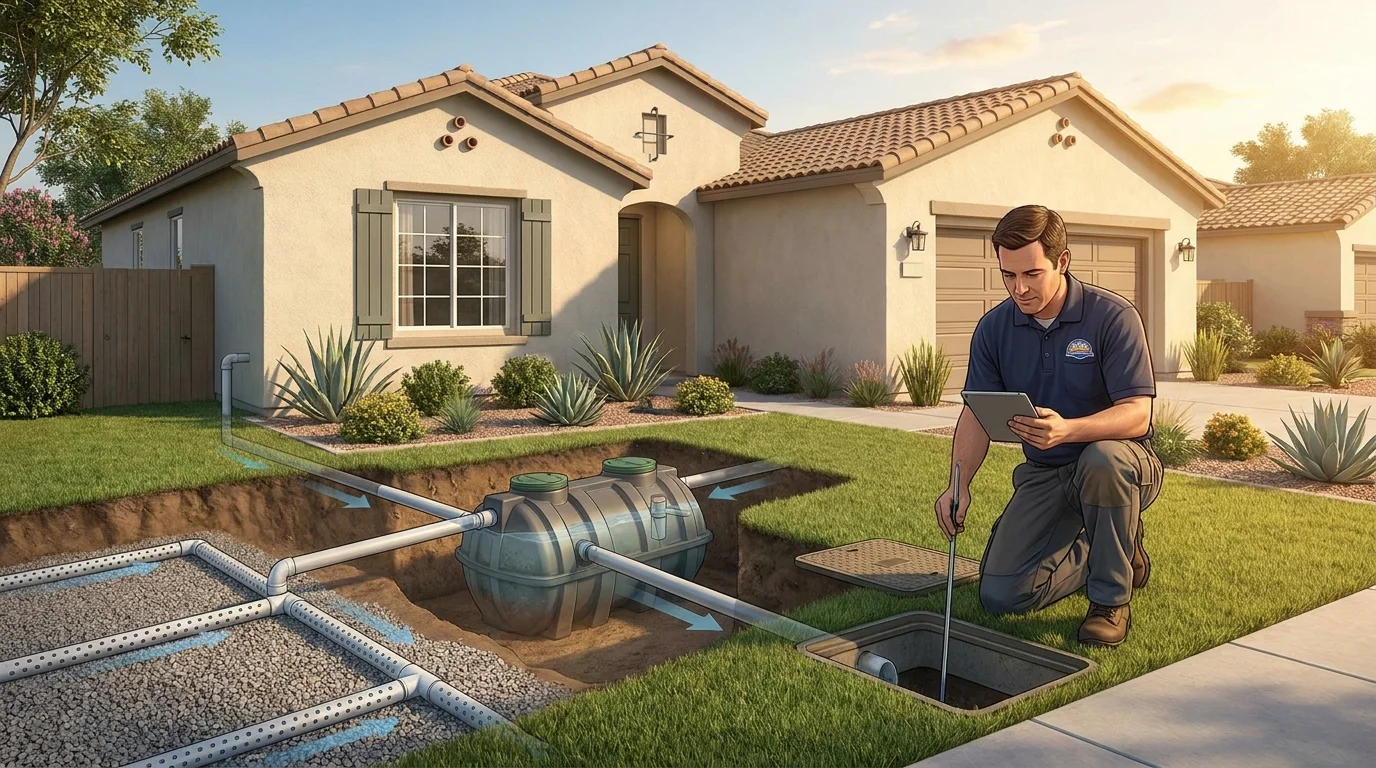
Everything that goes down your drains, toilets, and washing machine flows through one underground pipe to the septic tank. Inside the tank, solids settle to the bottom, grease floats to the top, and the liquid in the middle flows out to the drain field. In the drain field, the liquid soaks into the ground and gets naturally filtered by soil. That’s it. The whole system runs without electricity or moving parts.
If you’re coming from a sewer connection, the main difference is that your waste isn’t piped to a treatment plant. Your property handles it all. If you want a deeper comparison, read our septic vs. sewer breakdown for San Diego homeowners.
Step 1: the tank separates everything
Wastewater from your home enters one end of the tank through an inlet baffle. That baffle slows the incoming flow so it doesn’t disturb what’s already settling inside.
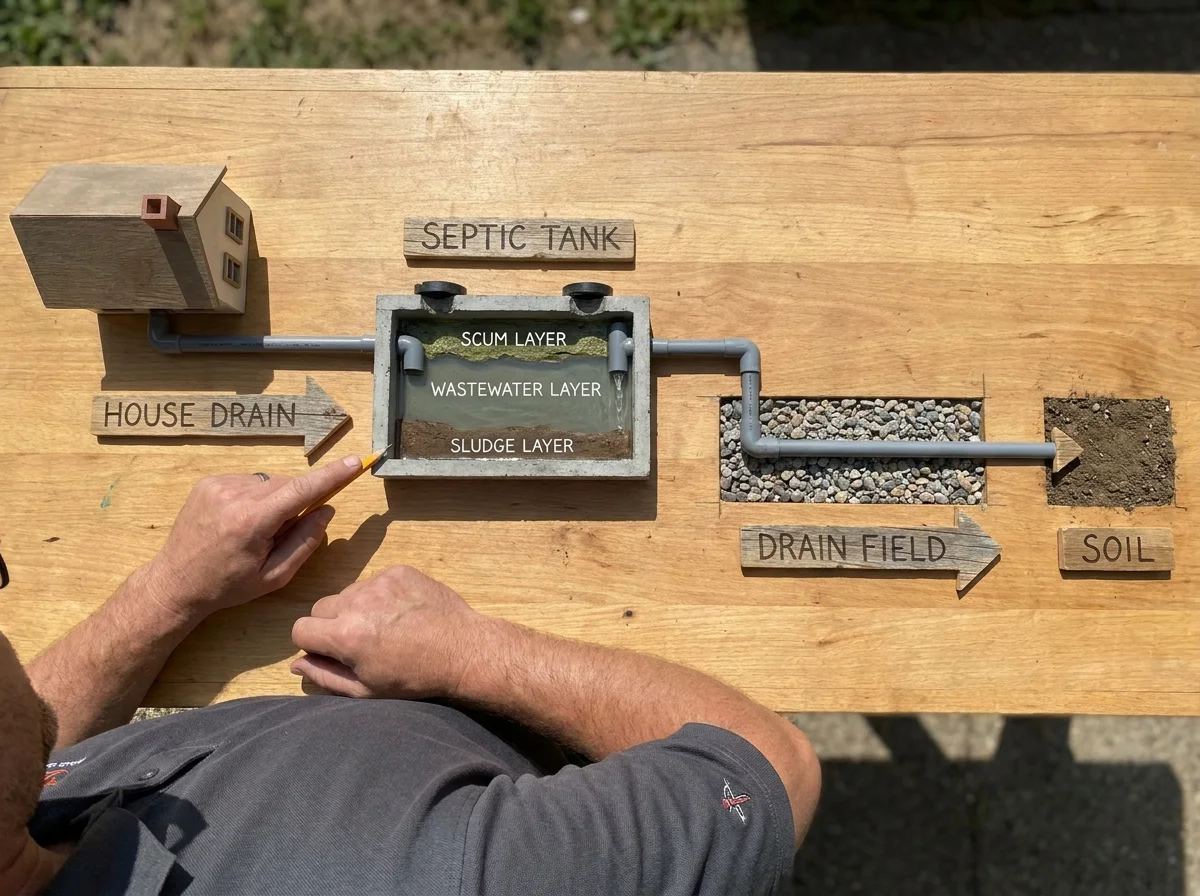
Inside the tank, three distinct layers form:
Scum floats on top. This is grease, oils, and anything lighter than water: soap residue, cooking fat that made it past the trap, and some paper fibers.
Effluent sits in the middle. This is the liquid layer. It’s not clean water, but it’s liquid enough to flow out toward the drain field.
Sludge sinks to the bottom. This is the heavy solid material: food particles, human waste, and anything else that doesn’t dissolve or float.
The outlet baffle on the far end lets only the middle layer (the effluent) pass through. It physically blocks the scum from floating out and the sludge from being carried along. A healthy baffle is critical. When baffles crack or collapse, solids reach the drain field and clog it fast. If you suspect baffle issues, baffle and tee replacement is worth checking before you have a bigger problem.
Step 2: the drain field finishes the job
The effluent leaving the tank flows into a network of perforated pipes buried in gravel-filled trenches. This is the drain field (sometimes called a leach field). The liquid seeps out of the pipes, moves down through the gravel, and enters the native soil.
Soil is a remarkable filter. As effluent passes through the top few feet of soil, bacteria and other microorganisms break down remaining pathogens. By the time the water reaches the water table, most contaminants are gone.
The drain field works because the soil stays aerobic: oxygen is present, and the right bacteria thrive. When a drain field gets waterlogged from heavy rain or excessive water use, oxygen gets pushed out. Anaerobic conditions set in. The wrong bacteria grow, and a thick biological mat (called a biomat) forms on the soil surface. That mat restricts flow. Once it’s bad enough, the field fails.
For a full picture of what can go wrong and what fixes are available, see our guide to what is a leach field and how does it fail.
What the bacteria actually do
You’ve probably heard that a septic system needs bacteria to work. Here’s what that means in practical terms.
Inside the tank, anaerobic bacteria (the kind that live without oxygen) break down solids in the sludge layer. They don’t eliminate everything, but they reduce the volume significantly over time. Without them, the sludge would build up much faster and you’d need to pump the tank every year or two instead of every three to five years.
In the drain field, a different set of bacteria does the heavy lifting. These aerobic bacteria (the oxygen-dependent kind) finish breaking down pathogens in the soil. They’re naturally present in healthy soil. Your job is to not disrupt them by flooding the field or introducing harsh chemicals.
This is why you’ll hear advice about not pouring bleach down drains in large quantities. A small amount of household bleach in laundry is fine. Dumping a gallon of drain cleaner weekly is not. It kills the bacteria in the tank and slows the breakdown process.
The US EPA’s SepticSmart program has solid, no-hype guidance on what homeowners should and shouldn’t send down the drain.
Why pumping matters
Bacteria do a good job, but they don’t eliminate solids completely. Sludge accumulates at the bottom of the tank over time. Scum builds at the top. If you never pump the tank, those layers eventually crowd out the middle liquid layer. Effluent starts carrying solids to the drain field. Once solids clog a drain field, you’re looking at an expensive repair or full replacement.
Pumping removes the accumulated sludge and scum, restoring the tank’s capacity. In San Diego County’s climate, most households need to pump every three to five years, depending on household size and water use. A larger household pushes more volume through the system and fills the tank faster.
Our guide to how often to pump a septic tank in San Diego goes deeper on the math. For the service itself, see our septic pumping page.
During a pump-out, a licensed technician also inspects the tank. That’s when baffles, inlet and outlet conditions, and early signs of structural problems get caught. It’s cheap preventive care compared to what a drain field repair costs.
What this means for how you use your home
Understanding the system makes the day-to-day rules make sense rather than feeling arbitrary.
Water use. Your drain field needs time to absorb effluent. Spread water use through the week. Don’t run the dishwasher, washing machine, and multiple showers in the same two-hour window. If you’re hosting a large gathering, spread laundry loads across two days.
What you flush. The tank can only break down organic material. Flushable wipes, paper towels, feminine hygiene products, and dental floss don’t break down and clog the system. Only toilet paper and human waste go in.
Chemicals. Stick to septic-safe versions of cleaning products when possible. A normal amount of household cleaners is fine. High-volume chemical dumping is not.
Parking and planting. Heavy vehicles compact the soil over the drain field and can crush pipes. Tree roots seeking moisture will find their way into any crack. Keep the drain field area clear of both.
Signs something’s wrong. Slow drains throughout the house, gurgling sounds in pipes, wet spots or unusually green grass over the drain field, and sewage odors indoors or out are all signals the system needs attention. Don’t wait. Early intervention is almost always cheaper. For a full rundown of warning signs, see our septic warning signs guide.
If your system is aging or if you’re looking at septic system installation for a new property, understanding how the components work together helps you ask the right questions and make better decisions. The San Diego County Department of Environmental Health oversees permitting for installations and major repairs in unincorporated areas, and its requirements are worth knowing before you start a project.
When to call us
Septic work in California requires a CSLB Class C-42 sanitation system contractor, and you can verify any contractor’s license there before hiring. If you’re seeing warning signs, smell something off, or just want a baseline inspection on a home you recently bought, don’t wait until it’s an emergency. Call us at (858) 925-5546 and we’ll connect you with an experienced local septic crew for a same-day estimate.