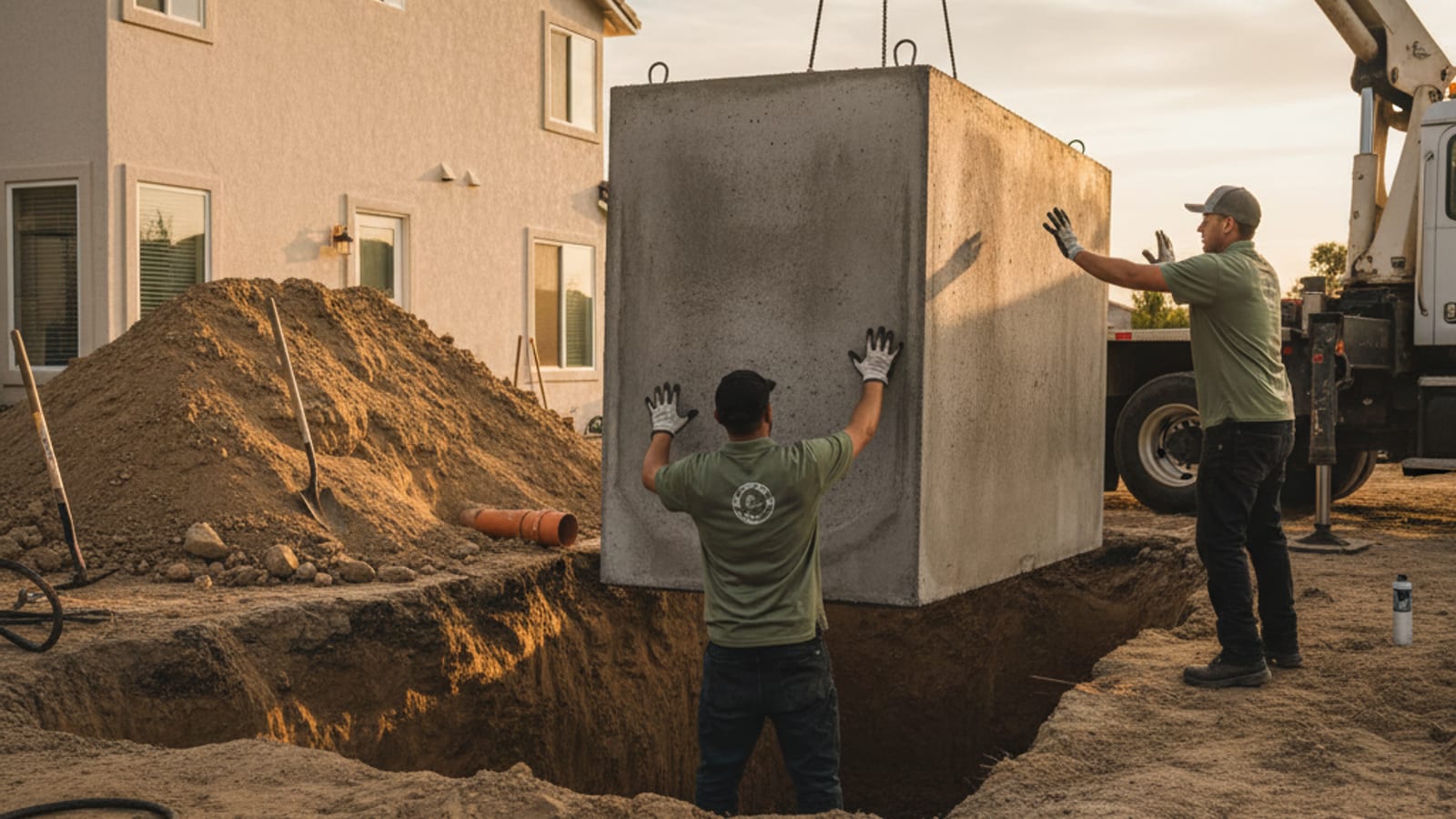
Most homes in central San Diego connect to a city sewer. Most homes in the backcountry run on septic. The difference comes down to where the house sits. If there’s a sewer main in the street, you connect to it and pay a monthly bill. If there isn’t, your wastewater stays on your property in a septic system you maintain yourself. East County and rural inland areas are almost all septic.
Here’s how to tell which one you have, what each actually costs, and why the line falls where it does in this county.
How to tell which one your property has
Three quick checks tell you fast.
Look at your bill. A sewer connection shows up as a monthly or bimonthly charge from the city or a wastewater district. No sewer line item usually means septic.
Walk the yard. Septic systems have lids or risers in the ground, often a rectangular or round cap a few feet across, plus a drain field area that stays a little greener or a little drier than the rest of the lawn. If you can’t find yours, our guide on how to find your septic tank walks through it.
Check the address. Homes in unincorporated San Diego County, the further you get from city centers, are far more likely to be on septic. Julian, Ramona, Alpine, Jamul, Valley Center, Fallbrook, and Pine Valley are heavily septic.
Why the line falls where it does here
Sewer lines follow population density. Running a main costs a lot per foot, so cities build them where houses are packed close together. Out in the backcountry, lots are big, homes are spread out, and the math never works for a public main. So those properties treat wastewater on site with septic.
San Diego County has a lot of this terrain. Large rural parcels, hilly ground, and long distances between homes mean septic is the standard, not the exception, across East County and the inland north. That’s not a downgrade. A well-kept septic system can run for decades.
What each one costs
The cost shape is different. Sewer is a steady monthly bill with little upfront. Septic is mostly upfront and at intervals, with low ongoing cost between services.
| Item | Sewer | Septic |
|---|---|---|
| Monthly cost | $40 to $90 sewer charge | $0 |
| Routine service | None for the homeowner | Pump every 3 to 5 years |
| Pumping cost | N/A | About $375 to $650 per pump |
| Inspection | N/A | $200 to $725 depending on scope |
| Big-ticket repair | Lateral line, city’s main is on them | Drain field or full system |
| New connection or install | $5,000 to $25,000+ to tap a main | $15,000 to $40,000+ to install |
Over 10 years, a sewer home pays roughly $5,000 to $11,000 in sewer charges with no maintenance work of its own. A septic home pays little month to month but covers its own pumping and the occasional repair. Neither is automatically cheaper. It depends on the property and how the system is treated.
For local numbers, see our septic pumping cost in San Diego for 2026.
What septic asks of you that sewer doesn’t
Sewer is hands-off. You flush, you pay the bill, the district handles the rest. Septic puts you in charge of a working system on your own land. That means a few real responsibilities.
Pump on schedule. Every 3 to 5 years for most households. Skip it and solids carry into the drain field, which is the expensive part to replace.
Watch what goes down the drain. Grease, wipes, and harsh chemicals shorten a system’s life. Septic is more forgiving than people think, but it isn’t a sewer.
Protect the drain field. No parking, no heavy structures, no deep-rooted trees over it. Keep roof and surface runoff away from it.
Know the warning signs. Slow drains, gurgling, sewage smell, or soggy ground over the field. Catch these early and the fix is small. Our post on septic warning signs of a failing system covers what to watch for.
The permit and county piece most national guides skip
This is where generic septic articles fall short for San Diego homeowners. Septic here is regulated by the San Diego County Department of Environmental Health and Quality, often called the DEH or DEHQ. They run the onsite wastewater treatment system program, the OWTS rules that govern how systems get installed, repaired, and replaced.
A few things that matters for:
New systems and major repairs need a county permit. You can’t just install or rebuild a drain field on your own. The DEHQ reviews the plan first.
New installs require a percolation test. Often called a perc test, it measures how fast soil absorbs water. It decides whether the soil can support a septic system and how big the drain field has to be. Much of East County has expansive clay soil that drains slowly, which means larger fields and higher install costs.
Drought and groundwater rules add weight. The county watches septic density and groundwater impact closely in rural basins. That affects what gets approved and where. A sewer home never deals with any of this. A septic home should understand it before buying, building, or replacing.
If you’re installing or replacing a system, our septic system installation page covers how the permit and perc test process works in this county.
Which is better
Neither, on its own. The better question is which fits the property.
If your home already connects to a sewer, stay on it. There’s rarely a reason to switch, and you can’t add septic where a main exists in most cases.
If your home is on septic, that’s almost always because there’s no sewer to connect to. Switching to sewer means a connection only exists if a main reaches your street, and tapping in runs $5,000 to $25,000 or more plus the monthly charge after. For most backcountry properties, that option doesn’t exist at all. Septic is the system, so the real goal is keeping it healthy.
A maintained septic system is not a problem to solve. It’s an asset to protect.
Frequently asked questions
How do I know if my San Diego home is on septic or sewer? Check for a monthly sewer charge on your utility bill, look for tank lids or risers and a drain field in the yard, and consider the location. Unincorporated and backcountry areas like Ramona, Julian, and Alpine are mostly septic.
Can I connect my septic home to the sewer? Only if a sewer main reaches your street, which is uncommon in the backcountry. Where it’s possible, tapping in costs $5,000 to $25,000 or more, plus the ongoing monthly sewer charge. Many rural properties have no main to connect to.
Is septic more expensive than sewer? Not always. Sewer is a steady monthly bill. Septic is low month to month but you cover pumping every 3 to 5 years and the occasional repair. Over a decade the totals often land close, depending on the property.
Do I need a county permit for septic work in San Diego? New systems and major repairs do. The San Diego County Department of Environmental Health and Quality reviews plans, and new installs require a percolation test on the soil. Routine pumping does not need a permit.
Why are backcountry homes on septic instead of sewer? Sewer mains follow dense neighborhoods because they cost a lot per foot. Rural parcels are large and spread out, so a public main never gets built. Those homes treat wastewater on site with septic.
Talk it through with someone local
If you’re buying a backcountry home, building on a rural lot, or just trying to figure out what you’ve got, we can help you read the system and the county rules around it. Tank Pro SD covers all of San Diego County, including the backcountry, with upfront quotes and no guesswork. Call (858) 925-5546.