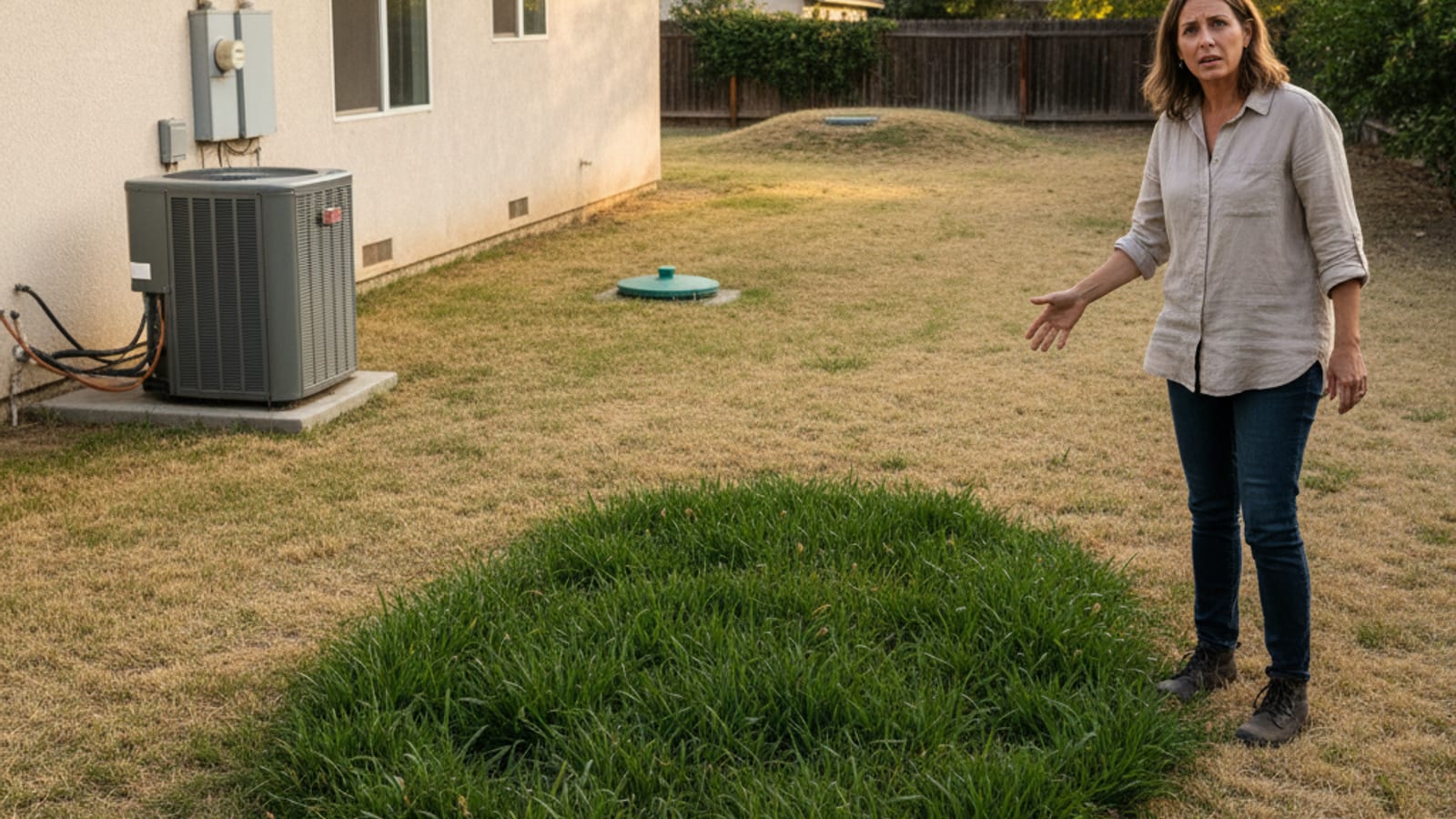
A failing septic system never stops politely. It backs up on a holiday weekend, smells up the yard before a graduation party, or fails an escrow inspection 48 hours before close.
The good news: the system always tells you it’s in trouble first. Catching the early signs is the difference between a $400 repair and a $20,000 drain field replacement.
Here are the 9 signs that mean you need service this week, ranked roughly from “noticeable” to “this is an emergency.”
1. Slow drains throughout the house
Not one slow drain, which is a clog in a single fixture. We mean every shower, every sink, every toilet draining sluggishly together.
That pattern almost always means the tank is full or the outlet line is restricted. A pump usually solves it. Cost: $325 to $525. If the slow drains return within weeks, the drain field is the issue and you need a real diagnostic call.
2. Gurgling sounds from drains and toilets
That liquid burping sound is air being pushed back through the drain trap because effluent can’t move out fast enough. Often the first sign, appearing before any backup.
Cost if caught now: routine pump and inspection, under $600. Cost if ignored: much more, because the underlying problem keeps progressing.
3. Sewage smell in the yard
A healthy septic system is essentially odorless from the outside. Smell over the tank means a broken or missing baffle, a cracked lid, or seal failure. Smell over the drain field means effluent is reaching the surface, which is early-stage field failure.
Cost: baffle/lid repair runs $250 to $900. Drain field repair starts at $850 for jetting; full replacement is $8,000 to $25,000.
4. Wet spots or standing water above the drain field
Even on a dry week. Effluent is breaking through to the surface because the field can’t absorb fast enough.
This is past “early warning.” Cost: $850 to $2,400 for jetting and rehab if the field has any life left; $8,000 to $25,000 for replacement if it doesn’t. Get the diagnostic before assuming the worst.
5. Unusually lush, dark-green grass over the drain field
A drain field acting as a fertilizer source means it’s leaking nutrients to the surface. Often shows before any visible water or smell.
Cost: same range as #4. Catching it at the green-grass stage gives more options.
6. Sewage backing up at the lowest fixtures
Floor drain in the basement, ground-floor shower, ground-floor toilet: these back up first because they’re at the bottom of the gravity system.
This is an emergency. Cost: at minimum a same-day pump ($325-$525) plus the after-hours dispatch fee ($189). If a backed-up tank caused interior damage, biohazard cleanup and floor restoration add real money.
7. Surface ponding right above the tank lids
Water pooling on the lids after a moderate rain means the lids aren’t sealed (gas-tight gasket failure) or the riser is letting groundwater in. Eventually causes baffle damage and tank corrosion.
Cost: $250 to $750 to reseal lids and risers properly. Cheap insurance.
8. Septic alarm sounding (ATU systems)
Aerobic Treatment Units have a high-water alarm and an air-pump fault alarm. Either one needs response within a day, not a week. A silent run can cause permit violations and field damage.
Cost: ATU service calls run $250 to $750 for diagnostic and basic component swap. Major rebuilds are higher.
9. Lid collapse or settled, unstable lids
Old steel lids and improperly bedded concrete lids can collapse. This is a child and pet safety emergency more than a septic emergency.
Cost: new polyethylene lid + riser is $325 to $650 installed. Don’t wait on this one.
The 4 signs that mean weeks, not days
Some signs are early enough to plan around:
- It’s been 5+ years since the last pump and you have no measurement records. Schedule routine service this month.
- You’re buying or selling a home with a septic system. Get a full inspection done in the first 7 days of escrow so you have time to negotiate.
- You changed water use significantly (added a renter, started running multiple loads of laundry per day, installed a garbage disposal). Get a sludge measurement to reset your pump interval.
- Your drain field is older than 25 years and has never been jetted or rehabbed. Schedule a preventive inspection before the first warning sign. It’s much cheaper than crisis response.
What to do right now
If you’re seeing any of the first 9 signs, call within the week. Most can be diagnosed in a single visit, and the price gap between “fix it now” and “wait three months” is dramatic on every one of them.
Tank Pro SD covers the whole county with same-week scheduling on diagnostic and routine work, and 24/7 dispatch on real emergencies. (858) 925-5546.