Common questions. Straight answers.
Most of what homeowners ask before they hire us. Don't see your question? Call us at the number in the header.
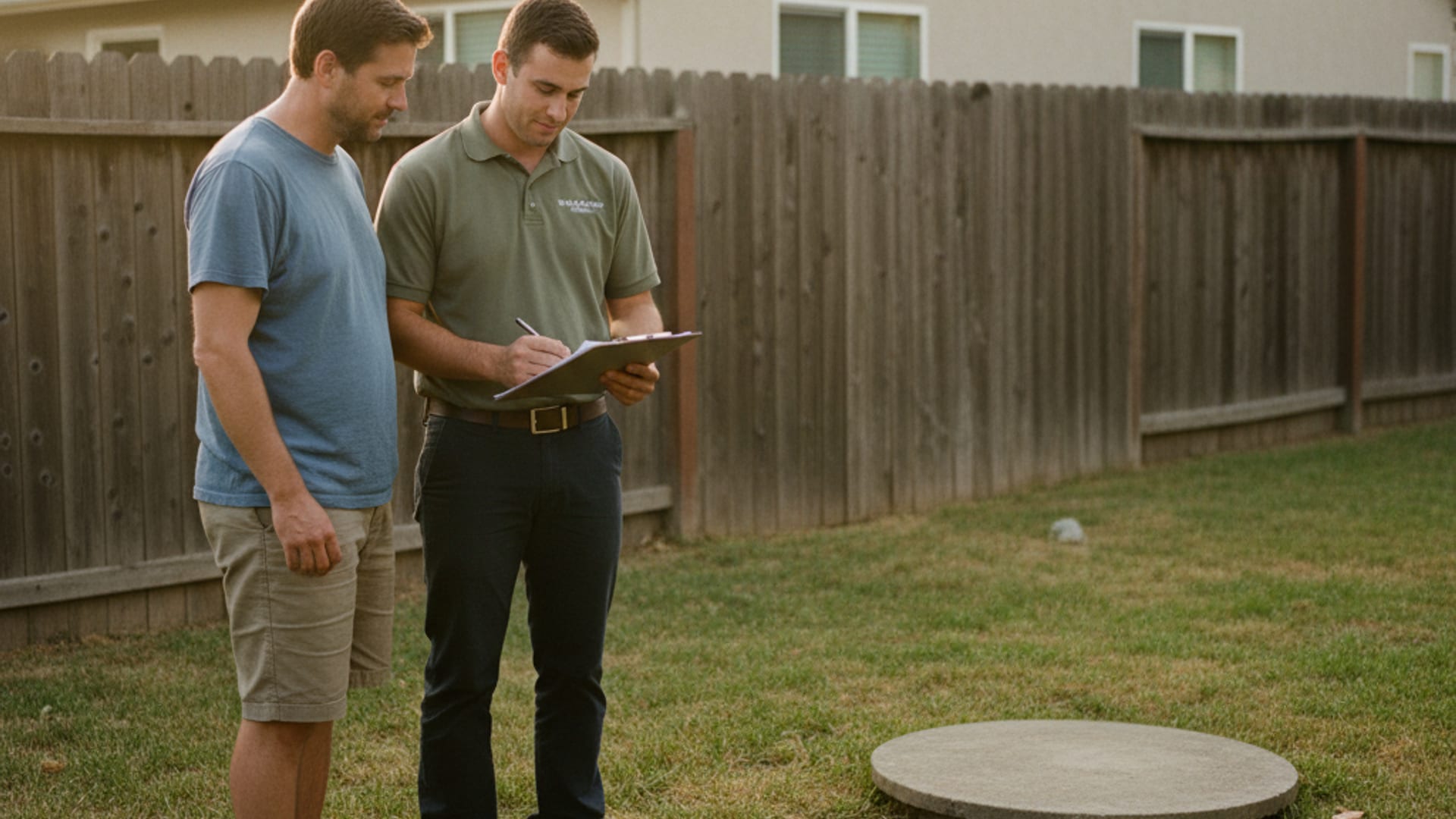
What does septic pumping cost and how does it work?
How much does septic pumping cost in San Diego?
Standard residential pumping runs $325 to $525 for a 1,000-1,500 gallon tank with reasonable lid access. Larger commercial tanks, restaurant grease traps, and emergency overflow situations are quoted separately. Add $50-$150 if we need to dig to find a buried lid; add $325-$650 if you decide to install risers at the same visit (pays for itself by the next pump).
How fast can you get here for routine pumping?
Most pumps are scheduled within 5 business days across San Diego County. Emergency calls, active backups, surface overflow, get same-day or same-night dispatch. Typical after-hours response is 90-180 minutes from the call.
How often should I pump my septic tank?
Every 3 to 5 years for a typical 1,000-1,500 gallon tank serving a 3-4 person household. Larger households or smaller tanks need pumping more often; garbage disposals roughly double the solids load. We measure sludge depth at every visit and tell you the actual next-pump date based on real measurements.
What if you cannot find my tank lid?
We bring a probe and a county records search printout to most jobs. If your tank is buried under landscaping, a deck, or pavement, we'll locate it and quote the dig before we touch a shovel. Installing a riser at the same visit usually pays for itself before the next pump-out.
How much do new tanks and full septic systems cost?
How much does a new septic tank installation cost?
Tank replacement runs $3,500 to $8,500 for a like-for-like 1,000-1,500 gallon install on most San Diego County properties, fully permitted. Larger tanks, polyethylene tanks for tight access, and concrete tanks with risers added on quote separately.
How much does a full new septic system cost?
Standard 3-bedroom gravity systems run $15,000 to $28,000, perc test, design, permit, install, and inspection. Pressure-dosed systems run $20,000 to $35,000. Engineered Treatment Units (ATU) for marginal soils run $30,000 to $55,000. We quote with all alternatives so you can compare honestly.
Concrete tank or polyethylene tank?
Concrete lasts 40+ years and is the SD County default for residential. Polyethylene is lighter, ships in tighter access, and resists corrosion in high-water-table or aggressive-soil sites, but needs careful backfill to avoid deformation. Both are county-approved; we recommend based on your access, soil, and budget.
How long does a full new system install take?
Plan 2 to 4 months from first call to closed permit. The actual digging and installing is one week. The other 7-15 weeks are county DEH timelines: perc test scheduling, plan review, permit issuance, and final inspection. We push paper on the slow steps so you're not the one chasing the county.
Do you offer financing?
We work with regional financing partners for septic projects over $5,000. Approval is usually next-day. Ask when we quote, we'll walk through monthly payment options alongside cash pricing.
How often should I have my septic system inspected?
How often should I have my septic system inspected?
Annually if you want to maximize drain field life. At minimum every 3 years (paired with a pump). Real-estate purchases and sales always require a full inspection. Insurance carriers and lenders increasingly require documented annual maintenance.
What is included in a septic inspection?
Visual inspection of tank lids, baffles, and tees; sludge and scum depth measurement; effluent filter cleaning; hydraulic load test on the drain field; visual surface inspection above the field; camera inspection of the inlet and outlet lines; and a written 6-10 page report with photos, measurements, and pass/fail summary.
Do you offer maintenance plans?
The Tank Pro Plan starts at $189/year and includes annual inspection, sludge measurement, effluent filter cleaning, biological additive program, priority emergency dispatch, and 10% off any repairs. Pumping is scheduled separately at the right interval based on actual measurements. Month-to-month, no long-term contract.
How do I know if my drain field is failing?
How do I know if my drain field is failing?
Top warning signs: standing water or wet spots above the field, sewage smell in the yard especially after rain, slow drains throughout the house even after a recent pump, unusually lush dark-green grass over the field, or backups at the cleanout that return within weeks of pumping. Any one of these is a service call this week, not next month.
Can a failing drain field be saved?
Sometimes. Biomat buildup, root intrusion, and partial line failure can often be reversed with hydro-jetting, line replacement, or distribution-box rebalancing. Soil exhaustion and saturated trenches usually cannot. The pros we send diagnose first and give you the honest answer with both repair and replacement numbers.
How much does drain field replacement cost?
Full replacement runs $8,000 to $25,000 depending on size, soil class, access, and whether the site needs a pressure-dosed or alternative system. Sites that fail perc may require an Engineered Treatment System, adding $5,000-$15,000.
What counts as a septic emergency?
What counts as a real septic emergency?
Sewage backing up into the home, sewage on the surface in the yard, septic alarm sounding (ATU systems), tank lid collapse (child-safety hazard), and active commercial backups losing revenue. A slow drain that has been worsening for a week is usually next-business-day, not 11pm. We help you decide on the call.
Do you have a real on-call technician?
Yes. After-hours calls go to a dispatcher with a rotating on-call tech who lives in San Diego County, not a national answering service. Typical response is 90-180 minutes weekday nights, 2-4 hours weekends and holidays.
How much does after-hours service cost?
A $189 after-hours dispatch fee on top of standard pump and repair rates. No double-time multipliers. Tank Pro Plan customers pay no after-hours dispatch fee at all, one of the bigger reasons people sign up.
Ready for septic service that actually answers the phone?
Call for a free quote. Same-week scheduling on routine work. 24/7 dispatch on emergencies.