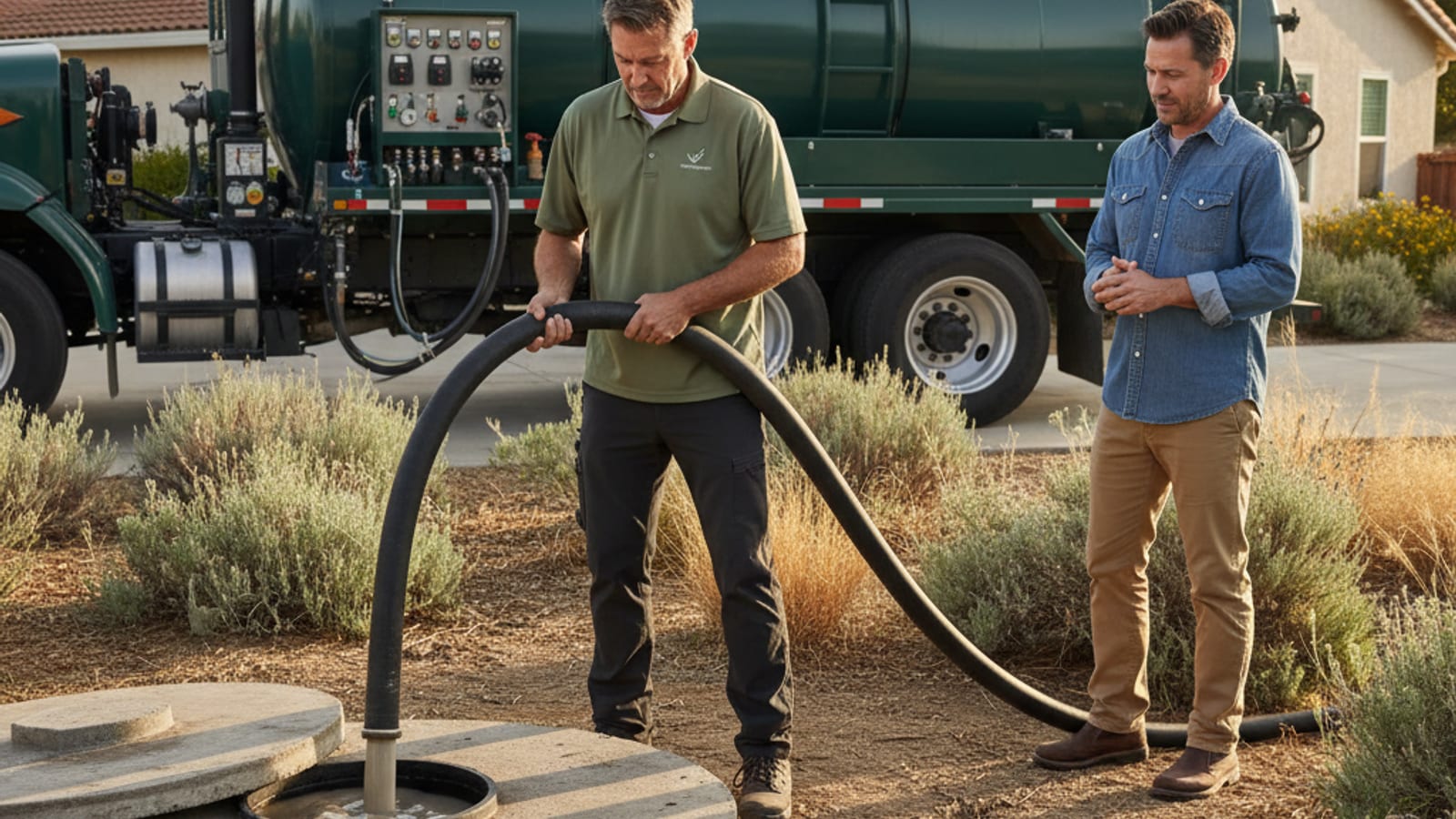
Most San Diego County homes need a septic pump every 3 to 5 years. The exact number depends on tank size, how many people live there, and whether you run a garbage disposal. Backcountry homes on smaller tanks or older systems often land closer to every 2 to 3 years. The only way to know your number is to measure sludge and scum, not guess from a calendar.
This guide gives you a real frequency framework for the way people actually live out here, plus the county rules that quietly change the math.
The baseline frequency framework
The national rule of thumb is every 3 to 5 years, and the EPA agrees. But that range is wide for a reason. A retired couple on a 1,500-gallon tank can stretch toward 5 years. A family of five with a garbage disposal on a 1,000-gallon tank can hit the limit in under 3.
Here’s a starting point you can adjust from. These are years between pumps, assuming an average household with no garbage disposal.
| People in home | 1,000 gal tank | 1,250 gal tank | 1,500 gal tank |
|---|---|---|---|
| 1 to 2 | 5 to 6 | 6 to 8 | 8 to 10 |
| 3 to 4 | 3 to 4 | 4 to 5 | 5 to 6 |
| 5 to 6 | 2 to 3 | 3 | 3 to 4 |
| 7 or more | 1 to 2 | 2 | 2 to 3 |
Run a garbage disposal regularly and you shorten every one of those numbers by about a year. Food waste turns into sludge fast, and sludge is what fills a tank.
What actually triggers a pump
A calendar is a reminder, not a measurement. The real trigger is how full the tank is. A pro measures two layers with a sludge probe, and the EPA’s pump-now thresholds are clear:
- The bottom of the scum layer comes within 6 inches of the outlet
- The top of the sludge layer comes within 12 inches of the outlet
- Sludge and scum together make up more than 25 percent of the tank depth
When you pump on a schedule that’s a little aggressive for your household, you protect the part that’s expensive to replace: the drain field. A tank pump is a few hundred dollars. A failed leach field can run five figures. The whole point of pumping is keeping solids out of the field.
San Diego County specifics that change your number
This is where the national guides stop and the local reality starts. A few things about living here push your frequency tighter than a generic table suggests.
Backcountry homes often have smaller or older tanks. A lot of septic out here is in East County and the backcountry: Julian, Ramona, Alpine, Jamul, Valley Center, Fallbrook, and Pine Valley. Older rural properties were sometimes built with 750 to 1,000-gallon tanks that are undersized for a modern family. Smaller tank means more frequent pumping, full stop.
Drought changes how your soil drinks. San Diego County swings between dry years and heavy rain. During long dry stretches, the soil around a drain field can compact and accept water more slowly, which stresses the system and makes a clean, on-time tank more important. After a wet winter, a saturated field can back up into the tank. Either way, a tank that’s near capacity has no margin.
Expansive clay soil is common in East County. A lot of inland and backcountry lots sit on clay that swells and shrinks with moisture. That movement can crack tanks, shift baffles, and slow a drain field. On those soils, staying on the shorter end of your pump range buys you safety.
Vacation rentals and casitas spike usage. A property in Julian or Ramona that runs as a short-term rental, or a home with a guest casita, can push wastewater volume far past what the tank was sized for. Treat a busy rental like a larger household and pump more often.
What San Diego County DEH expects from you
The county doesn’t send you a pump reminder, but the rules still matter. Septic systems here are regulated by the San Diego County Department of Environmental Health and Quality (DEHQ), under the state’s OWTS policy. OWTS stands for Onsite Wastewater Treatment Systems, which is the formal name for septic.
A few things worth knowing:
- New systems and major repairs need a county permit. Installing, replacing, or significantly altering a system requires DEHQ review, and the site usually needs a percolation test to prove the soil can handle the effluent.
- Disposal has to be at a permitted facility. A legitimate pumper hauls your waste to an approved treatment site and documents it. That paper trail matters if you ever sell.
- At a property sale, the system gets scrutinized. Many San Diego County real estate deals include a septic inspection, and a tank that’s overdue or failing becomes a negotiation problem. Staying current protects your home’s value. Our real estate septic inspection guide walks through what buyers and sellers should expect.
You don’t need to memorize the code. You need a pumper who works inside it and gives you records.
How to stretch your interval safely
You can earn the longer end of your frequency range with a few habits:
- Skip or rarely use the garbage disposal. It’s the single biggest driver of fast sludge buildup.
- Spread laundry across the week instead of doing six loads on Saturday.
- Keep wipes, grease, and “flushable” products out of the system. None of it breaks down.
- Fix running toilets and dripping fixtures. Extra water shortens the life of the drain field.
- Skip the additive products. Most do nothing measurable. We covered why in our piece on whether septic additives actually work.
What you can’t do is skip the pump itself. Stretching past your number to save a few hundred dollars is how a manageable tank becomes a ruined field.
Frequently asked questions
How often should I pump my septic tank in San Diego County? Most homes need a pump every 3 to 5 years. Smaller or older backcountry tanks, larger households, and homes with garbage disposals often need it every 2 to 3 years. Measuring sludge and scum is the only way to know your exact interval.
Does living in the backcountry change how often I pump? Often, yes. Many East County and backcountry properties have smaller or older tanks, sit on expansive clay, and run as vacation rentals. All of those push your pump frequency tighter than a national average.
What happens if I wait too long to pump? Solids overflow the tank and reach the drain field, which clogs the soil that filters your wastewater. A late pump is cheap. A failed drain field can cost five figures to repair or replace.
Do I need a county permit just to pump my tank? No. Routine pumping doesn’t need a permit. Permits through San Diego County DEHQ are for installing, replacing, or significantly repairing a system, and those usually involve a percolation test.
How do I know if my tank is overdue right now? Watch for slow drains across the whole house, gurgling, sewage odor in the yard, or soggy ground over the drain field. Those are warning signs the tank is full or backing up. Don’t wait for them, but if you see one, call.
Get a straight answer on your tank
If you’re not sure when your tank was last pumped, the honest move is a measurement, not a guess. We give upfront quotes, serve all of San Diego County including the backcountry, and work inside county DEH rules with documented disposal. See our septic pumping service for what a real pump-out includes.
Call (858) 925-5546 and we’ll tell you where your tank stands and what it needs. No upsell, no pressure.