Your septic system sits underground, out of sight, doing its job every day. Most homeowners don’t think about it until something goes wrong. Knowing how long your system should last, and what shortens that timeline, is the difference between a planned upgrade and a costly emergency.
The short answer: typical lifespans by component
A septic system isn’t one thing. It’s several components working together, and each has its own lifespan.
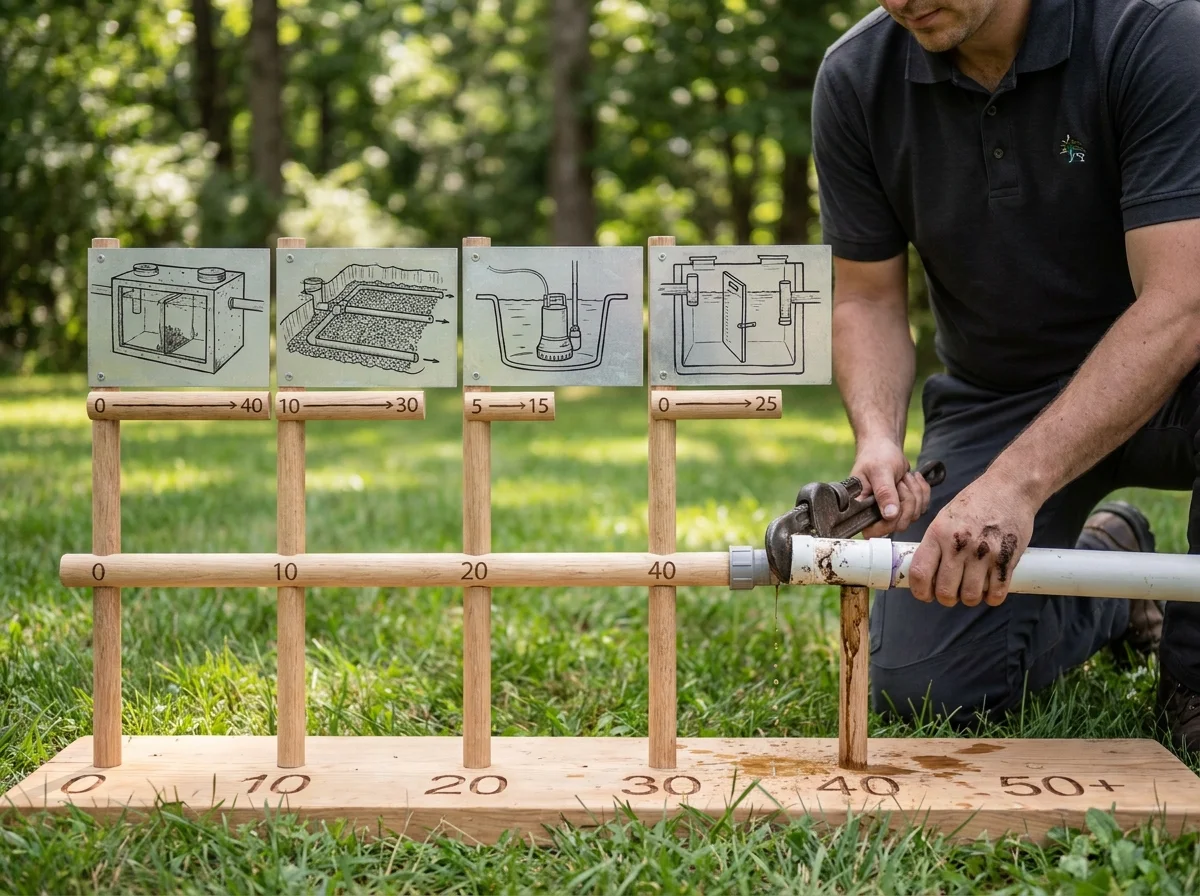
Concrete tanks are the most common type in San Diego County homes built decades ago. A well-maintained concrete tank can last 40 years or more. The weak point is the baffles inside, which are the inlet and outlet tees that direct flow. Concrete baffles deteriorate in 15 to 20 years. Plastic replacement baffles last much longer and are an easy upgrade.
Steel tanks were common in the mid-20th century. They corrode from the inside out, and most are approaching or past end of life. If your home was built between the 1940s and 1970s, there’s a real chance you have a steel tank. Average lifespan is 20 to 30 years, and many are already past that. A licensed inspector can tell you what you’re working with.
Drain fields (also called leach fields) are the buried network of perforated pipes that disperse treated wastewater into the soil. Expect 20 to 30 years in normal conditions. Poor soil, heavy water loading, or tree root intrusion can cut that to 10 to 15 years.
Submersible pumps (in systems that require them, like mound systems or ATUs) wear out faster than the tank. Plan on 7 to 15 years, depending on usage and quality.
Baffles and tees are often overlooked. Inspect and replace them every 15 to 20 years as part of routine septic maintenance.
What makes a septic system last longer
The biggest factor in septic lifespan is how the system is managed. Two identical systems installed the same year can differ by decades in how long they hold up.
Pumping on schedule. In San Diego County, most household systems need pumping every 3 to 5 years, depending on tank size and occupancy. Skipping pumps lets solids accumulate and overflow into the drain field, clogging the soil. That’s how a $500 pump job becomes a $15,000 drain field replacement. If you’re not sure where you stand on pumping, our post on how often to pump your septic tank walks through the variables.
Controlling water load. The drain field can only absorb so much water per day. High-efficiency toilets, water-saving showerheads, and spreading laundry loads across the week all reduce stress on the system. Dripping faucets and running toilets may seem minor, but a slow leak that adds 50 gallons a day will saturate a drain field over months.
Protecting the drain field. No vehicles, no heavy equipment, no trees within 10 feet. Compacted soil and root intrusion are two of the most common ways drain fields fail ahead of schedule.
Watching what goes down the drain. Septic systems depend on live bacteria to break down waste. Bleach, antibacterial soaps, and household chemicals kill those bacteria when used in large quantities. Grease coats the drain field pipes. “Flushable” wipes don’t break down in the tank. All of these shorten system life.
Regular inspections. San Diego County’s OWTS (onsite wastewater treatment system) rules require inspection for permitted repairs and installations, but routine inspections are worth scheduling every 2 to 3 years even when nothing seems wrong. Small problems found early are cheap. The same problems found late are not.
What kills a septic system early
Some things accelerate failure faster than others. These are the most common culprits we see in San Diego County.
Overloading with guests or added units. A system sized for a 3-bedroom home handles a consistent load. If you’ve added an ADU or regularly host large gatherings, the water volume may exceed what the system was designed for. Size matters, and aging systems have less reserve capacity.
Grease buildup. Cooking grease poured down the kitchen drain hardens in the tank and floats to the top as scum. Over time, it slows solids breakdown and eventually spills into the drain field. It’s one of the most preventable causes of early failure.
Flushing non-organics. Wipes, paper towels, feminine hygiene products, and cat litter don’t break down. They accumulate in the tank, fill it faster, and can block the outlet baffle.
Tree roots. Willow, eucalyptus, and fig trees are especially aggressive. Their roots seek moisture and will find septic pipes. Once roots penetrate perforated drain field pipes, the pipes fill and stop draining effectively.
Neglected repairs. A cracked lid, a failed baffle, or a slow-draining fixture are small problems. Left alone, each becomes a bigger one. A cracked lid lets in rainwater and soil. A failed baffle sends solids to the drain field. A slow drain turns into a backup.
San Diego’s clay-heavy soils. Parts of the county, especially inland areas, have dense clay soils with low percolation rates. These soils absorb effluent more slowly, which means the drain field works harder and ages faster. Systems in clay-heavy areas may need more frequent maintenance or, eventually, alternative drain field designs.
Signs yours is nearing the end
Not every symptom means the whole system is done. But some signs deserve serious attention. Our detailed breakdown of septic warning signs covers these in depth. Here’s what to watch for as a system ages.
Slow drains throughout the house. One slow drain is usually a pipe issue. Slow drains everywhere often point to a drain field problem.
Wet, spongy ground above the drain field. This means effluent is surfacing instead of absorbing. It’s a sign the soil is saturated or the pipes are blocked.
Odors near the tank or drain field. A properly functioning system doesn’t smell outside. Odors mean something isn’t processing correctly.
Sewage backups. Waste backing up into tubs or toilets is a late-stage sign. By the time you’re seeing backups, the system has been struggling for a while.
Unusually lush, green grass over the drain field. Grass that grows faster or greener than surrounding areas is feeding on surfacing effluent. It looks healthy. It’s not a good sign.
Age alone. If your drain field is 25 years old and you’ve had any of the above symptoms, start planning for replacement rather than waiting for failure.
Repair vs. replace as it ages
When a system starts showing problems, the question isn’t always “replace everything.” It depends on which component is failing.
A concrete tank with a cracked baffle or a failed lid can often be repaired for a few hundred dollars. A steel tank that’s corroded through is a different story. Patching corroded steel is temporary at best.
A drain field that’s overloaded but structurally intact may recover with a rest period and reduced water use. A drain field with root intrusion or biomat buildup (a layer of organic matter blocking soil absorption) often needs partial or full replacement.
Our post on drain field repair vs. replacement walks through how to make that call. The short version: if the tank is sound and the drain field has one isolated failure zone, repair is usually the right call. If the drain field is failing across multiple laterals and the system is over 20 years old, replacement is worth pricing out. A full septic system installation gives you a fresh 25 to 30 year runway with modern materials.
The EPA’s SepticSmart program is a solid resource for homeowners trying to understand when to act and what responsible maintenance looks like.
How to add years to your system
You can’t stop aging, but you can slow it down. Here’s what actually makes a difference.
Pump every 3 to 5 years. This is non-negotiable. It’s the single most effective maintenance step.
Install risers. If your tank requires digging every time it’s pumped, risers bring the access point to grade. That means faster service calls and less reason to skip a pumping cycle. Less reason to skip means you won’t.
Fix leaks inside the house promptly. A running toilet can add 200 gallons a day to your system. That’s the equivalent of several extra residents.
Avoid harsh chemicals. Use septic-safe cleaners. Limit bleach. Don’t run large amounts of antibacterial products down the drain.
Keep records. Note every pump, inspection, and repair. When you sell the house, those records matter. When a technician is diagnosing a problem, that history saves time and money. Septic inspection reports are the starting point for understanding what your system actually needs.
Work with a C-42 licensed contractor. In California, septic system work requires a CSLB Class C-42 Sanitation System Contractor license. Anyone doing permitted repairs, installations, or significant maintenance without it is working outside the law. You can verify a contractor’s license at the CSLB license check before any work begins.
A well-maintained concrete system in San Diego County can realistically last 40 to 50 years. The homeowners who hit that mark aren’t lucky. They’re consistent.
When to call us
If your system is over 20 years old, showing slow drains, odors, or wet spots above the field, it’s time for a professional assessment, not a wait-and-see approach. A thorough site inspection can tell you exactly which components are sound and which need attention. Call us at (858) 925-5546 for a same-day estimate.