Choosing the wrong tank size is one of the most expensive mistakes a homeowner can make. A tank that’s too small fills up fast, requires more frequent pumping, and can stress your drain field into early failure. Getting the number right before installation saves real money over the life of the system.
How septic tanks are sized
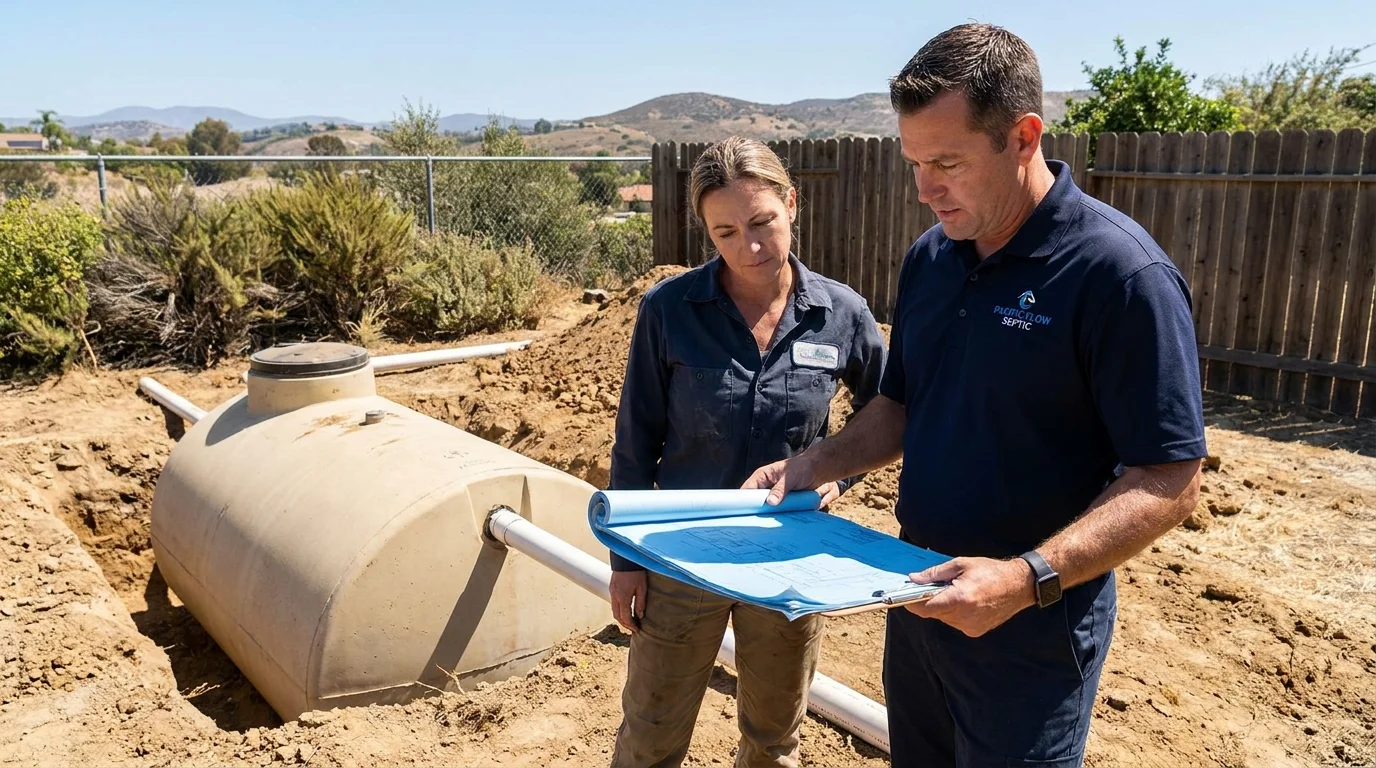
Septic tanks are sized by liquid capacity, measured in gallons. The tank needs to hold enough wastewater to allow solids to settle and scum to float before the clarified liquid flows to the drain field.
Two factors drive every sizing decision: daily water use and the amount of time solids need to settle. Engineers typically design for 24-48 hours of retention time. The more water a household produces each day, the larger the tank needed to maintain that window.
California and San Diego County use bedroom count as the baseline for estimating daily water use. A bedroom is treated as a proxy for one or two occupants producing roughly 75-100 gallons per person per day. This gives inspectors and designers a consistent starting point even before a household moves in.
The San Diego County Department of Environmental Health sets minimum tank sizes for all new and replacement installations through its OWTS (Onsite Wastewater Treatment System) permit program. Their minimums may exceed statewide baselines, so local code always governs. The California Water Boards OWTS Policy covers the statewide floor.
Tank size by number of bedrooms
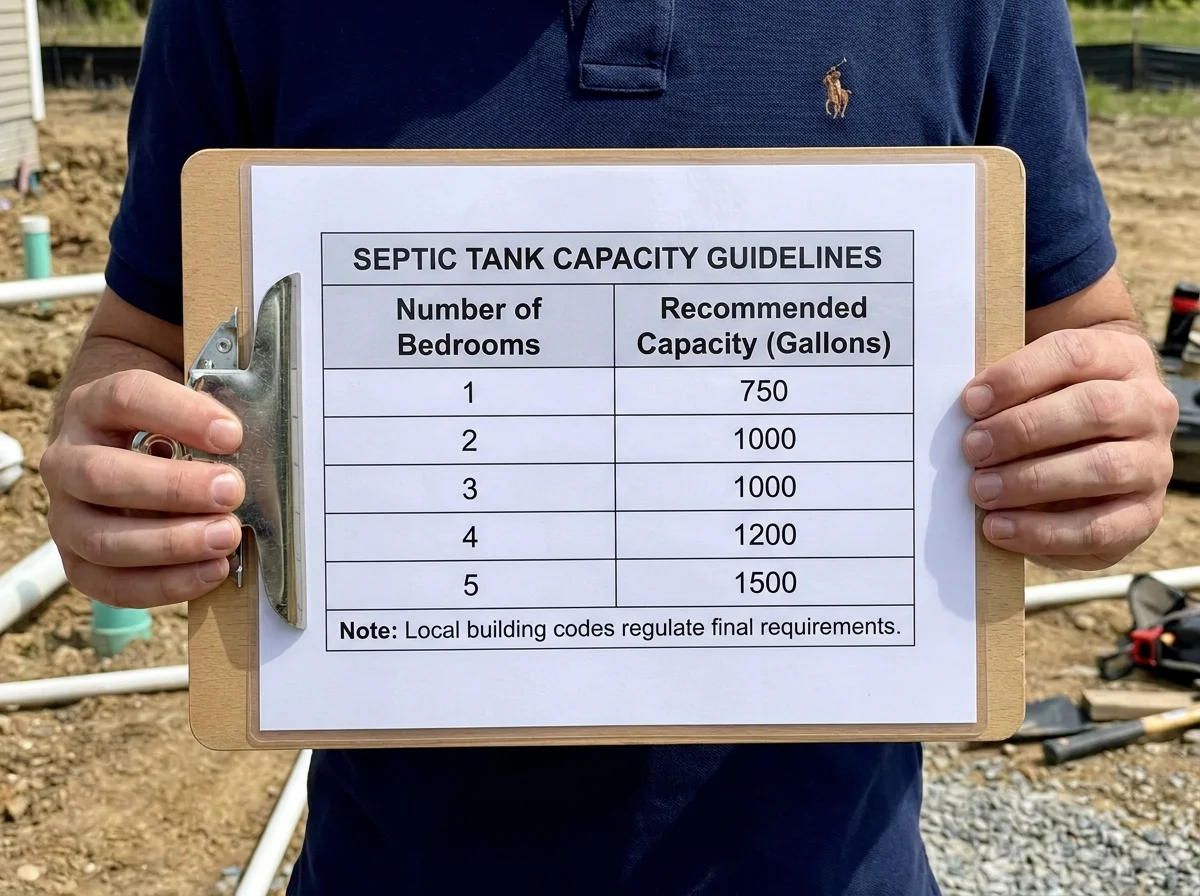
The table below reflects commonly applied general guidance. Use it for planning and conversations with your contractor. County code and a site evaluation determine your actual permitted size.
| Bedrooms | Estimated daily flow | Typical minimum tank size |
|---|---|---|
| 1-2 | 150-250 gal/day | 750-1,000 gallons |
| 3 | 250-360 gal/day | 1,000-1,250 gallons |
| 4 | 360-480 gal/day | 1,250-1,500 gallons |
| 5 | 480-600 gal/day | 1,500-2,000 gallons |
| 6+ | 600+ gal/day | 2,000+ gallons |
For most San Diego County single-family homes, a three-bedroom house lands at a 1,000-1,250 gallon tank. Four-bedroom homes typically need 1,250-1,500 gallons. These ranges match what we see permitted regularly in unincorporated areas of the county.
One thing to know: many SD County inspectors require a minimum 1,000-gallon tank regardless of bedroom count. Anything smaller is rarely approved on a new installation. If your home is smaller, plan for 1,000 gallons as a starting floor.
The cost difference between a 1,000 and a 1,500-gallon tank is often a few hundred dollars at installation time. Going larger upfront is almost always cheaper than upsizing later. You can read more about what drives the overall price in our post on septic tank installation cost in San Diego.
When household habits change the math
Bedrooms give you a baseline. Actual water use can push you well above it. Several common factors add up quickly.
Garbage disposals add significant organic load to the tank. A household with a garbage disposal produces roughly 50% more solids than one without. If you use one daily, your designer may specify a larger tank or more frequent pumping. The US EPA SepticSmart program recommends minimizing disposal use on septic systems for this reason.
Frequent houseguests matter more than most people expect. A family of three that regularly hosts weekend guests of four or five people is functionally running a five or six-person household on a three-person tank. Weeks of heavy use stress the system and reduce the scum and sludge settling time.
High-efficiency fixtures work in your favor. Low-flow toilets and showerheads reduce daily water volume and can make a modestly sized tank perform well. If you’re renovating and staying on septic, it’s worth the investment.
Laundry volume also shifts the math. Running multiple loads per day introduces a large slug of water and detergent into the tank at once. Spreading laundry across the week is better for the system than stacking it all on Saturday.
Hot tubs and pools with backwash that drains to the septic system can overwhelm a tank temporarily. Some San Diego County properties route backwash to a separate dry well or drywell to avoid this entirely. Ask your contractor before connecting any large-volume drain.
If any of these apply to your household, it’s worth discussing them with your installer before finalizing the tank size. Sizing conservatively now prevents problems that come with a system running near its daily limit.
San Diego County sizing rules of thumb
San Diego County’s unincorporated areas fall under the county’s OWTS program. Incorporated cities (San Diego, Chula Vista, El Cajon, etc.) generally follow state minimums but may have local amendments. The site-specific soil percolation test also influences system design, though perc rates affect drain field sizing more than tank volume.
A few county-specific patterns are worth knowing:
The county often requires a two-compartment tank for new installations. A two-compartment design provides better solids separation without increasing the tank footprint, so they’ve become standard on permitted installs.
Older tanks on properties with additions may no longer meet code for the updated bedroom count. If you’ve added a bedroom since your septic was installed, the county may require a tank upgrade before approving a permit for the addition. This comes up regularly in SD County’s rural east communities like Ramona, Valley Center, and Jamul.
Replacement tanks for existing systems typically need to meet current code minimums even if the original tank was permitted at a smaller size. A 750-gallon tank installed 40 years ago may need to be replaced with a 1,000 or 1,250-gallon unit today.
For permitted work, contractors must hold a valid C-42 Sanitation System Contractor license issued by the CSLB (Contractors State License Board). The county’s environmental health department issues the installation permit separately. One is a contractor credential; the other is project-specific approval. Both are required.
What happens if your tank is undersized
An undersized tank doesn’t fail dramatically on day one. It degrades gradually, and the early signs are easy to miss or dismiss.
The first thing you’ll notice is pumping frequency creeping up. A properly sized tank on a normal household needs pumping every 3-5 years. If you’re calling for service every 12-18 months, the tank is likely undersized for your actual load. Our guide on how often to pump your septic tank in San Diego walks through what’s normal.
As solids accumulate faster than they can settle, the partially treated effluent leaving the tank carries more particles into the drain field. Over time this clogs the soil around the leach lines, reducing absorption. Once the drain field is compromised, you’re looking at a repair or replacement that costs significantly more than a tank upgrade would have.
Slow drains, gurgling sounds from fixtures, and wet spots over the drain field are later-stage signals. By that point the problem has usually moved beyond the tank itself.
The fix at this stage is either upsizing the tank, adding a second tank in series, or in some cases redesigning the system entirely. All of these are more expensive and disruptive than sizing correctly at installation.
Sizing a tank for a new build or addition
New construction in San Diego County goes through a full OWTS design review. The county will review your bedroom count, site plans, soil report, and setback distances before issuing a permit. The tank size specified in the approved plans is what gets installed, so there’s less room for error here than on an existing system.
For additions, the county may require a site re-evaluation if you’re adding bedrooms. Even a single bedroom can push you into the next tank-size tier, particularly if you’re already at or near the minimum for your current count.
If you’re building or adding and want to future-proof the system, talk to your contractor about sizing one tier above the minimum. The marginal cost is low relative to the total project. A septic tank installation done right the first time is the least expensive installation you’ll ever have.
For a full picture of system components and what drives total project cost, the septic system cost guide for San Diego breaks it down by project type.
When to call us
Sizing questions get complicated fast when you factor in existing soil conditions, permit requirements, and household-specific water use. If you’re planning a new installation, replacing an old tank, or adding bedrooms to a septic-served home, talk it through before you commit to a size. Call us at (858) 925-5546 and we’ll connect you with an experienced local septic pro for a same-day estimate.