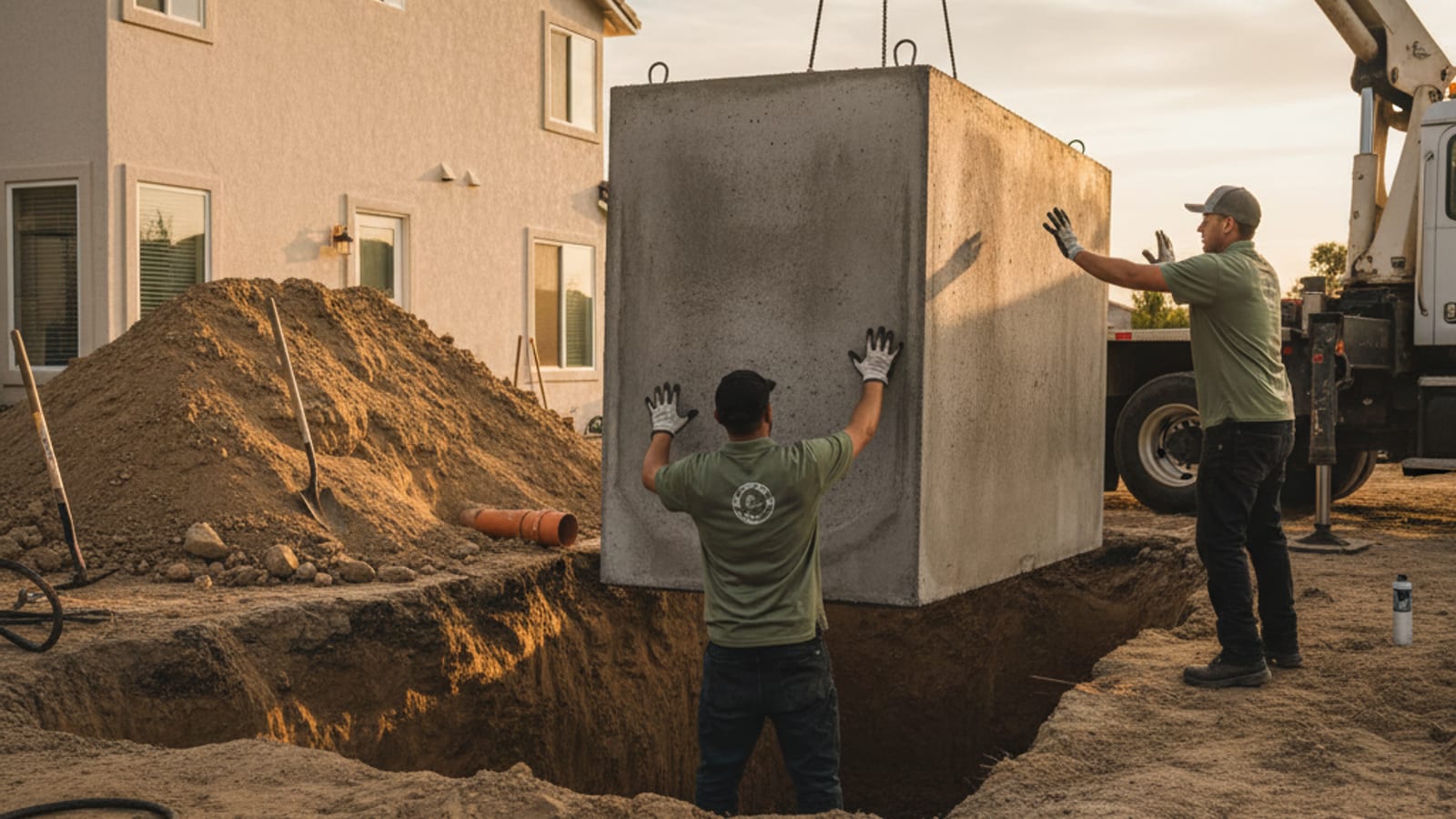
A new septic system in San Diego County costs $20,000 to $55,000 in 2026 for a full conventional install. That covers the tank, the drain field, a percolation test, the design, and the county DEHQ permit. National “average” numbers you’ll see online run lower because they leave out the soil testing and engineering our county actually requires. Here’s the real local breakdown.
Why San Diego runs higher than national averages
The big cost sites quote a national septic install at $3,500 to $12,500. That number is misleading here for three reasons.
First, those figures often price a tank-only swap, not a full system. A new tank by itself is cheap. The drain field, soil work, and permit are where the money goes.
Second, San Diego County requires a percolation test and an engineered design on most new systems. Our backcountry soils are difficult. Expansive clay near Ramona and Valley Center, decomposed granite around Julian and Pine Valley, and steep lots in Alpine and Jamul all push systems toward supplemental treatment instead of a simple gravity field.
Third, our properties are spread out. A new system in Fallbrook or Boulevard often means longer pipe runs, harder access for equipment, and more excavation than a flat suburban lot.
So the honest local range for a brand-new system is $20,000 on the low end for a straightforward gravity system on good soil, climbing to $45,000 to $55,000 for an engineered or pressure-dosed system on a tough backcountry lot.
Cost breakdown by component
Here’s where the money goes on a typical San Diego County install. We give upfront quotes, so you’ll see each line before any work starts.
| Component | Typical San Diego cost |
|---|---|
| Percolation test + soil evaluation | $1,500 to $3,500 |
| System design by an OWTS professional | $1,500 to $4,000 |
| County DEHQ permit + plan review fees | $1,200 to $3,000 |
| Septic tank (1,000 to 1,500 gal, concrete or poly) | $1,200 to $4,500 |
| Tank setting + plumbing connections | $3,000 to $6,000 |
| Drain field / leach field | $5,000 to $20,000 |
| Excavation, access, and site restoration | $3,000 to $10,000 |
| Supplemental treatment (if soil requires it) | $8,000 to $20,000 |
The two line items that swing the total most are the drain field and whether your soil forces a supplemental treatment unit. Both come straight out of the perc test results.
What the perc test decides
Everything starts with the percolation test. San Diego County DEHQ won’t issue a septic permit without one, and the result drives the entire system design.
The test measures how fast water drains through your soil. Fast-draining sandy or granite soil can support a conventional gravity drain field, the cheapest option. Slow clay soil means a larger field, a pressure-dosed system, or a supplemental treatment unit that cleans the effluent before it reaches the ground.
A perc test in San Diego County runs $1,500 to $3,500. You apply for a DEHQ percolation test permit, dig the test holes to county spec, and a county inspector or licensed OWTS professional witnesses the result. On a large backcountry parcel needing machine-dug holes, testing alone can approach $3,000.
If you’re buying raw land in Julian, Ramona, or Campo to build on, run the perc test before you close. A failed perc can mean a $20,000 swing in your build budget or no buildable lot at all.
System types and what they cost
The type of system your soil and lot allow is the single biggest cost factor.
Conventional gravity system. A tank and a standard drain field, with gravity moving the effluent. The cheapest option at roughly $20,000 to $30,000 installed in San Diego County. Needs good-draining soil and enough flat area for the field.
Pressure-dosed system. Adds a pump tank that doses the drain field evenly. Used on marginal soil or sloped lots, common in our hill country. Roughly $28,000 to $40,000.
Supplemental / advanced treatment (ATU). Treats wastewater to a higher standard before it hits the soil. Required on tight clay, high groundwater, or environmentally sensitive parcels. Roughly $35,000 to $55,000, plus an ongoing service contract the county requires you to keep.
Mound or engineered system. For the hardest sites, where the field is built up above grade. Top of the range, often $45,000 and up.
The county DEHQ permit process
San Diego County’s Department of Environmental Health and Quality, the DEHQ, regulates every onsite wastewater treatment system, or OWTS, in the unincorporated county. That covers nearly all septic work outside city limits, which is where almost all of our backcountry parcels sit.
The process runs roughly like this:
- Apply for a percolation test permit and complete the test.
- A licensed OWTS professional designs the system around the perc result.
- Submit the design to DEHQ for plan review.
- DEHQ issues the construction permit.
- Install the system.
- DEHQ inspects and signs off before backfill.
Plan review and permitting typically add 4 to 10 weeks to the project, longer in summer when the county is busy. Note that DEHQ updates its fee schedule periodically, so confirm current permit fees when you apply. We handle the paperwork and inspection scheduling as part of every install.
Skipping the permit is never worth it. Unpermitted septic work becomes a disclosure problem at resale and can void an insurance claim. The fees are a small slice of the total.
What pushes the price up in the backcountry
A few honest cost drivers we see often in East County and rural North County:
- Expansive clay soil near Ramona, Valley Center, and Jamul, which forces a larger field or supplemental treatment.
- Steep or rocky lots in Alpine, Pine Valley, and Boulevard, where excavation and access cost more.
- Long pipe runs on large parcels where the house sits far from the buildable field area.
- Groundwater and drought rules near streams and sensitive habitat, which can require advanced treatment.
- Decomposed granite around Julian and the mountains, which drains unpredictably and may need extra test pits.
None of these are upsells. They come directly from the perc test and your lot. We’ll show you exactly which ones apply before you commit.
How to keep the cost down
You can’t change your soil, but you can avoid wasted money. Run the perc test early so you know what system your lot needs before you budget. Size the tank to your real bedroom count so you don’t over- or under-build. Keep the drain field accessible for equipment to cut excavation cost. And maintain the system once it’s in, because a failed field replacement is the most expensive repair in septic.
For a new tank by itself rather than a full system, see our septic tank installation cost guide. If you’re buying or selling a property with an existing system, start with a real estate septic inspection before you talk install numbers.
Frequently asked questions
How much does a new septic system cost in San Diego County? A full new system runs $20,000 to $55,000 in 2026. Straightforward gravity systems on good soil sit near the low end. Engineered or supplemental-treatment systems on tough backcountry lots reach the high end.
Why is it more expensive than the national average? National averages often price a tank-only swap and skip soil testing and engineering. San Diego County requires a perc test and an OWTS-professional design on most systems, and our backcountry soils frequently call for advanced treatment.
Do I need a percolation test? Yes. San Diego County DEHQ won’t permit a new system without one. The result decides what type of system your lot can support and drives the whole cost.
How long does the permit take? Plan on 4 to 10 weeks for DEHQ plan review and permitting, plus a few days of actual installation. Summer runs longer.
Can I install a septic system without a permit? No. Unpermitted work creates resale disclosure problems and can void insurance claims. The permit fees are a small share of the total cost.
What if my soil fails the perc test? A poor perc result doesn’t always mean no system. It usually means a pressure-dosed or supplemental treatment design, which costs more. We’ll walk you through the options before you spend on design.
Get an upfront quote
Tank Pro SD sends pros who install new septic systems across San Diego County, including the backcountry, with county DEHQ permitting handled start to finish. We give upfront quotes, so you know the full number before any digging starts. Call (858) 925-5546 to talk through your lot and get a real estimate.