Your kitchen produces fats, oils, and grease every single service. Without a functioning grease trap, all of it goes straight into the sewer line. San Diego County inspectors know this, and so does your plumber when he’s clearing a backup at 11 p.m. on a Saturday.
What a grease trap does and why it clogs
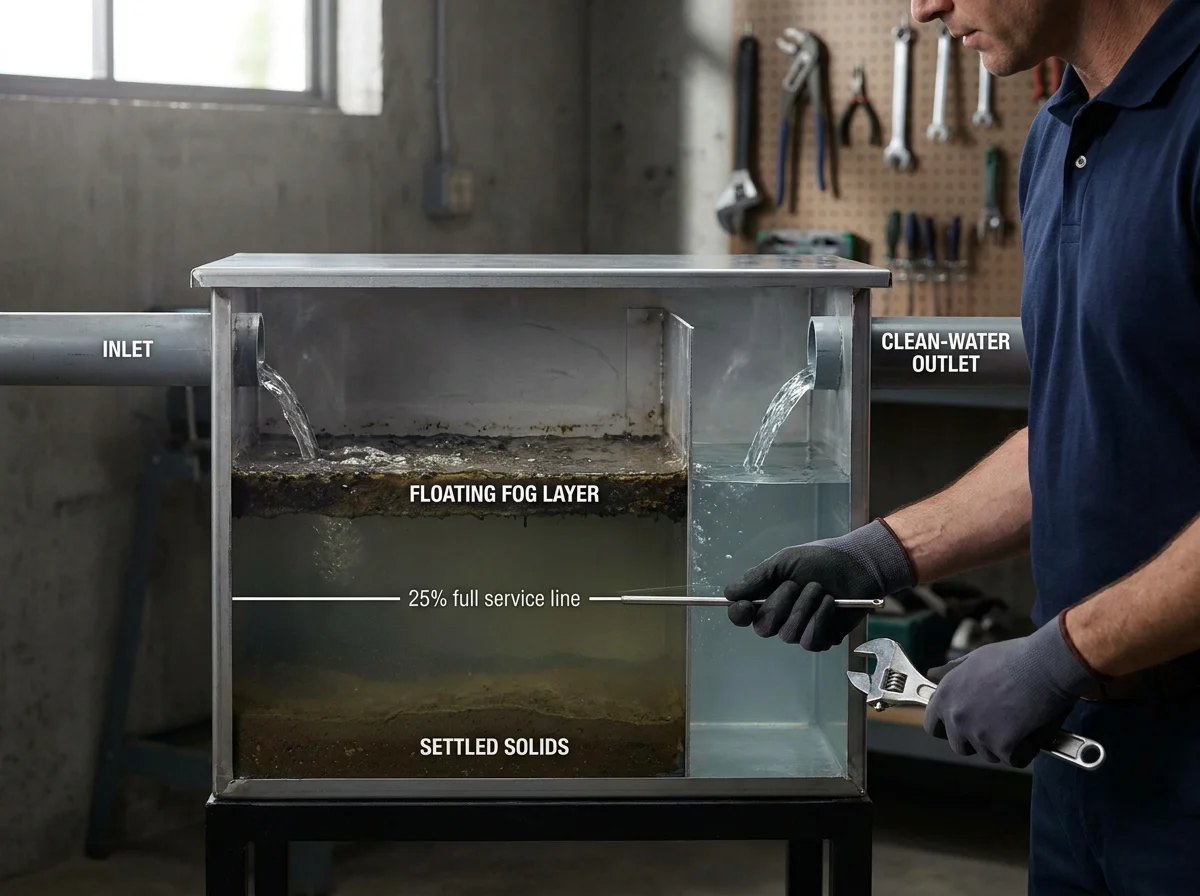
A grease trap is a tank, usually under your sink or outside your building, that intercepts wastewater from the kitchen before it reaches the municipal sewer. Inside the tank, water slows down long enough for grease to float to the top and solids to sink to the bottom. Clean water flows out the outlet pipe in the middle.
The problem is physics. Grease solidifies as it cools. Every batch of fryer oil, every pan of bacon fat, every wipe of the saute station ends up in that tank. Over time, the floating FOG layer (fats, oils, grease) thickens. The solid layer at the bottom builds up. The zone of clean water in between shrinks.
When that sandwich narrows too much, the trap stops working. Grease bypasses the baffles and moves into the sewer line. That’s where it re-solidifies, clings to pipe walls, and eventually causes a blockage.
A grease trap is not the same as a septic tank. Septic tanks handle all household or building wastewater via biological digestion in a drain field. A grease trap intercepts only kitchen discharge and relies on physical separation, not biology. If your restaurant is on a septic system and you’re also dealing with general wastewater capacity questions, read our guide to commercial septic service to understand how those two systems interact.
How often does a grease trap need cleaning?
The answer depends on your trap size and your kitchen’s volume. San Diego County enforces what’s commonly called the 25% rule: a grease trap must be pumped when the combined depth of the FOG layer and the settled solids reaches 25% of the trap’s total liquid depth. At that point, the trap is legally full.
In practice, most high-volume restaurants (busy breakfast spots, fast-casual with heavy fryers, full-service dinner houses) hit 25% every 4-6 weeks. Lower-volume operations, like a small cafe or a bar with limited kitchen output, may go 8-12 weeks between services.
Factors that push frequency up:
- High-volume frying (fish and chips, fried chicken, donuts)
- Large catering events in addition to regular service
- Older traps with smaller capacity
- Staff who pour hot grease directly into drains
Factors that allow longer intervals:
- Mostly grilled or baked menus
- Grease interceptors (larger outdoor tanks, often 500-1,500 gallons)
- Consistent staff training on scraping plates before washing
Grease interceptors are the outdoor, in-ground version of the under-sink trap. They’re larger, they handle more volume, and they require the same 25% rule but may only need service quarterly rather than monthly. If you’re unsure which type you have, look for a small access lid under your three-compartment sink or a larger concrete or fiberglass lid in your parking lot or grease pad area.
What happens if you skip it (fines, backups, shutdowns)
Skipping grease trap cleaning has three predictable consequences, and none of them are cheap.
Sewer violations and fines. San Diego’s Metropolitan Wastewater Department (MWD) requires food service establishments to maintain grease traps and produce cleaning records on request. Inspectors can show up during normal business hours. If your trap is over the 25% threshold, you’re in violation. First-time fines typically run $100-$500 per day, but repeat violations can reach $1,000 per day and trigger a formal compliance order.
Backups and emergency calls. When grease bypasses your trap and hits the sewer line, it doesn’t always stay there. It can back up into your floor drains, your three-compartment sink, or your prep area. An emergency pump-out during service hours costs two to three times what a scheduled cleaning costs, and the health department may require you to close until the problem is resolved.
Health department action. A sewage backup in a food prep area is an automatic closure. Getting back open requires a health inspector sign-off, which means you’re at the mercy of their schedule, not yours. A three-day closure over a $200 cleaning that didn’t happen is a painful math problem.
Grease trap neglect is also a leading cause of sanitary sewer overflows (SSOs), which San Diego County takes seriously under its MS4 permit obligations. SSOs that reach storm drains can trigger fines from the San Diego County Department of Environmental Health and create liability for your business beyond the sewer authority.
The cleaning process, step by step
A professional grease trap service isn’t complicated, but it has to be done correctly or you end up restarting the clock on a half-cleaned trap.
Step 1: Measure the trap. The technician opens the trap and measures both the FOG layer depth and the settled solids depth. These numbers go on your service manifest, which is your proof of compliance. Most San Diego operators are required to keep service records on-site for at least two years.
Step 2: Pump the contents. The full contents of the trap, FOG, solids, and water, are pumped into a vacuum truck. This is not a job for a shop vac or a standard sump pump. The waste is regulated as FOG waste and must be transported and disposed of at an approved facility.
Step 3: Scrape and rinse the walls. Once emptied, the technician scrapes the interior walls and baffles to remove any caked-on grease. The inlet and outlet baffles are checked for damage. A cracked or missing baffle defeats the entire purpose of the trap.
Step 4: Inspect and document. Before the lid goes back on, the condition of the baffles, lid gaskets, and inlet/outlet pipes is documented. Any deterioration gets noted so you can address it before it becomes an emergency.
Step 5: Return the trap to service. A small amount of clean water is added back to restore the liquid depth, and the trap is sealed. Your service record is signed and dated.
The whole process typically takes 45-90 minutes for an under-sink trap and 2-4 hours for a large outdoor interceptor.
San Diego compliance and the 25% rule
San Diego County enforces grease trap requirements through the MWD’s Fats, Oils, and Grease (FOG) Control Program. Food service establishments (FSEs) are required to install, maintain, and regularly service approved grease removal devices.
The 25% rule is the standard threshold used in San Diego. Here’s how to calculate it yourself: measure the total liquid depth of the trap in inches. Calculate 25% of that number. If the combined depth of your FOG layer plus your bottom solids equals or exceeds that number, you’re at the service threshold.
Example: a trap with 24 inches of liquid depth has a 6-inch service threshold (25% of 24). If your FOG layer is 2 inches and your solids layer is 4.5 inches, you’re at 6.5 inches combined. You’re over the line.
Most San Diego FSEs are also required to keep a cleaning log. The log should include the date of service, the name and license of the service provider, the measured FOG and solids depths before service, and a note on trap condition. When a county inspector asks to see your records, the log is your first line of defense.
If you’re also operating a kitchen on a property with a septic system, the FOG compliance rules still apply to your grease trap, and your septic system has its own separate maintenance schedule. Our post on commercial septic service for restaurants and wineries covers how those two systems coexist on the same property.
Contractors doing grease trap installation or repair in California need a CSLB C-42 (Sanitation System Contractor) license. You can verify a contractor’s license on the CSLB website before you hire. Pumping and cleaning services have their own licensing requirements under the waste hauler permit system, separate from the C-42 for installation work.
Setting up a service schedule
A reactive approach to grease trap cleaning almost always costs more than a scheduled one. The math is simple: emergency pump-outs carry a premium, fines add up fast, and a closure is a category of loss you can’t fully recover.
The best starting point is a baseline measurement. If you’ve never had your trap professionally measured, a service call that includes measuring your FOG and solids depth tells you where you currently stand and how quickly you’re accumulating. From there, a provider who knows your kitchen volume can build a realistic cleaning interval.
Most San Diego restaurants end up on one of three schedules: monthly, every 6 weeks, or quarterly. Monthly is common for high-volume kitchens with lots of frying. Every 6 weeks works well for mid-volume operations with a mixed menu. Quarterly is typically reserved for low-volume kitchens or large-capacity outdoor interceptors.
A service contract with a licensed provider handles the scheduling and documentation for you. Your service records are maintained, your cleaning intervals are set to your actual usage, and you don’t have to think about it until there’s a problem.
For restaurants that are also managing a full septic system, septic tank cleaning follows a separate schedule from your grease trap, typically every 3-5 years depending on system size and usage. The two systems don’t share a schedule, but they can share a service provider if you work with someone licensed for both.
If you’re newer to the compliance requirements, the US EPA’s SepticSmart program covers basics on how wastewater systems work, which is useful background even for commercial operators who are primarily dealing with sewer-connected properties.
When to call us
If your trap is approaching the 25% threshold, has been more than 60 days since its last service, or you’ve had an inspector flag your records, it’s time to schedule. A professional can pump the trap, measure and document the results, and give you an honest assessment of whether your current schedule fits your actual volume.
Call us at (858) 925-5546 for a same-day estimate.