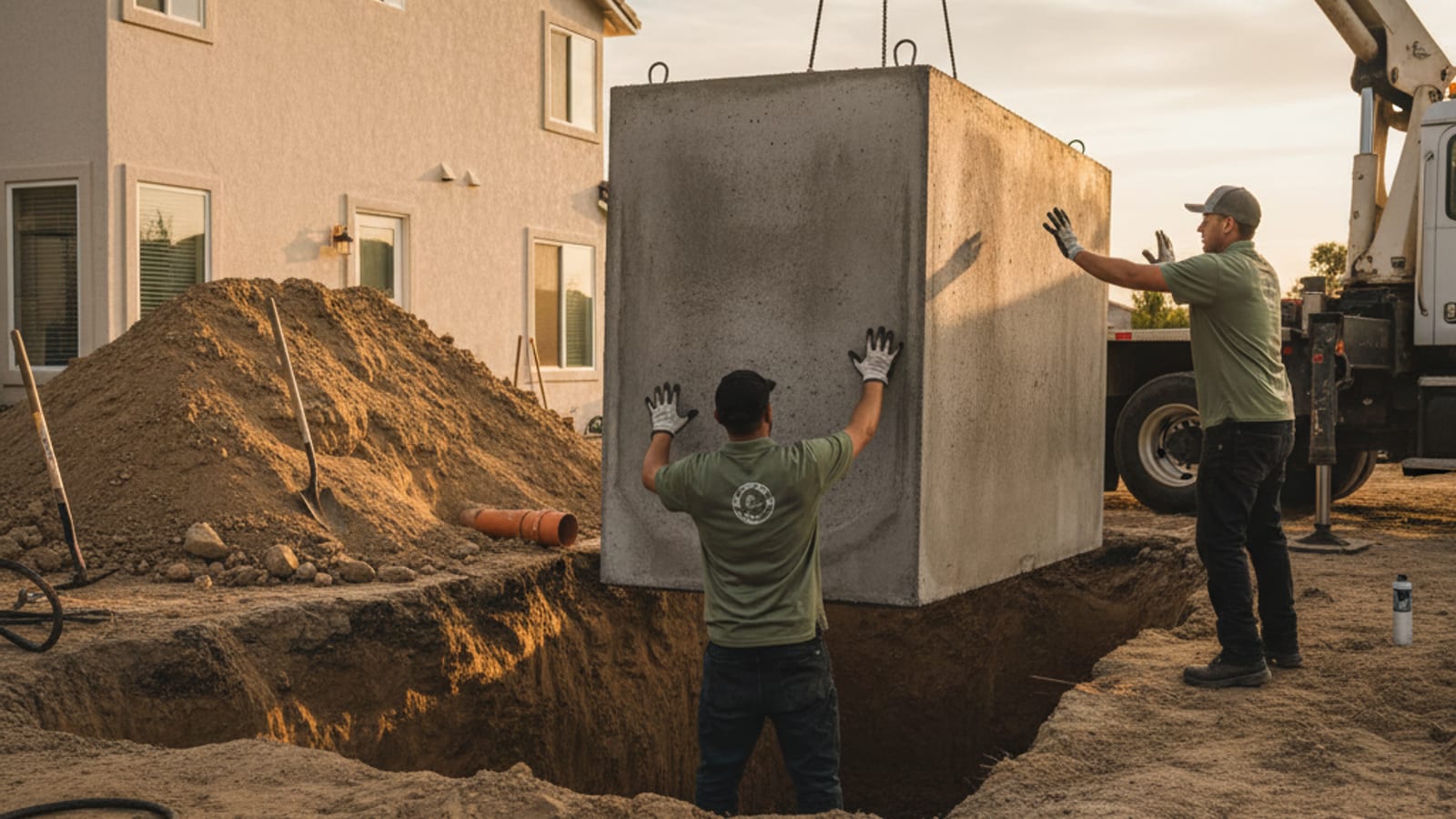
A new septic tank install in San Diego County is a serious project. It’s a 30+ year decision, requires a county permit, and costs real money. Here’s what to budget, what’s included, and how the timeline actually works.
Tank-only replacement vs. full system install
The first thing to clarify: are you replacing just the tank, or the entire system (tank + drain field)?
Tank-only replacement. Your existing drain field is healthy and you’re swapping the tank because it cracked, collapsed, or rusted through (steel tanks past life). Runs $3,500 to $8,500 for a like-for-like 1,000-1,500 gallon install.
Full system install. A new tank AND new drain field. This is most new construction, ADU additions, and replacement after drain field failure. Runs $15,000 to $55,000 depending on system type and soil class.
This guide covers tank-only replacement. For full systems, see our septic system installation cost guide.
What’s included in a tank replacement
A complete tank replacement project includes:
- County DEH permit, covering application, plan submittal, and fees ($350-$650)
- Locate and disconnect the old tank, pump and dispose of contents
- Demolition or abandonment of the old tank per county standard
- Excavation for the new tank
- Bedding prep (gravel base for concrete, sand for polyethylene)
- Tank delivery and setting, with a boom truck for concrete and lighter setting for poly
- Inlet line connection (4-inch SDR-35 from house, properly sloped)
- Outlet line connection to existing drain field
- Inlet baffle, outlet baffle, and effluent filter install
- Riser stack to grade with bolt-down lids and gas-tight seals
- Backfill with engineered fill where required
- County inspection coordination and final sign-off
- Site cleanup and basic restoration
Concrete vs. polyethylene
The two viable options in San Diego County:
Concrete tank. $3,500 to $8,500 installed. Lasts 40+ years. Heaviest, requires boom truck access. Default for most residential sites where access allows. Resists soil pressure and root intrusion well.
Polyethylene tank. $4,500 to $9,500 installed. Lasts 25 to 40 years depending on backfill and soil chemistry. Lighter, ships in tighter access, resists corrosion in aggressive-soil sites. Requires careful bedding and backfill to prevent deformation. Often the right choice for tight access (no boom truck path) or high-water-table sites.
We recommend based on access, soil, and budget. Both are county-approved.
County DEH permitting timeline
The actual digging and installing is 1 to 2 days. The full project timeline is driven by the county Department of Environmental Health, not the work:
- Permit application and plan submittal: 1 to 3 days from us
- County plan review: 2 to 4 weeks (variable, longer in summer)
- Permit issuance: 2 to 5 days after plan approval
- Install: 1 to 2 days
- Final county inspection: scheduled within 1 to 2 weeks of install completion
- Permit close-out: within a week of passing inspection
Total: 4 to 8 weeks from first call to closed permit. The dig itself sits in the middle of that timeline.
We schedule the dig only after the permit is approved, so you don’t have an open hole sitting in your yard for weeks.
Why permitting matters
Two reasons unpermitted septic work is a bad idea:
Resale. Real-estate inspections always check for permitted septic work. Unpermitted installs become a buyer-side disclosure issue and often kill or stall escrows. Re-permitting after the fact is more expensive than permitting up front.
Insurance and liability. A claim related to a septic system installed without a permit can be denied. The cost difference between permitted and unpermitted work is small ($350-$650 in fees plus a few hours of paperwork). The cost difference at claim time is dramatic.
Any reputable C-42 contractor won’t do unpermitted septic work. If a contractor offers to skip the permit “to save you money,” walk away.
What can push the cost up
Common upcharges that are honest:
- Difficult access such as narrow side yards, retaining walls, or mature landscaping. Adds 10-30%.
- Pavement or hardscape removal, meaning pulling and replacing pavers, concrete, or decking. Quoted separately based on scope.
- Old steel tank disposal, which is heavier and more involved than concrete or poly disposal.
- Drain field pre-tie-in inspection, sometimes needed if it’s been years since the field was looked at. We bundle this when sensible.
- Larger tank size. Going from 1,000 to 1,500 gal adds $300-$500. Going to 2,000+ gal is custom-quoted.
- Pressure-dosed retrofit, adding a pump tank for marginal soil drainage. $2,500-$5,000 over base.
Should you upsize while you’re at it?
If your house has more bedrooms or higher water use than the original tank was sized for, replacement is the time to upsize. A 1,000-gallon tank serving a 4-bedroom home is undersized by current code; replacing with a 1,500-gallon tank for a few hundred dollars more eliminates that problem for the next 30+ years.
Financing
Most septic projects over $5,000 qualify for regional contractor financing with next-day approval. Ask when you get a quote, and a good contractor will walk through monthly payment options alongside cash pricing.
Schedule a quote
Tank Pro SD does residential and small-commercial tank installs across San Diego County, fully permitted through county DEH. (858) 925-5546.