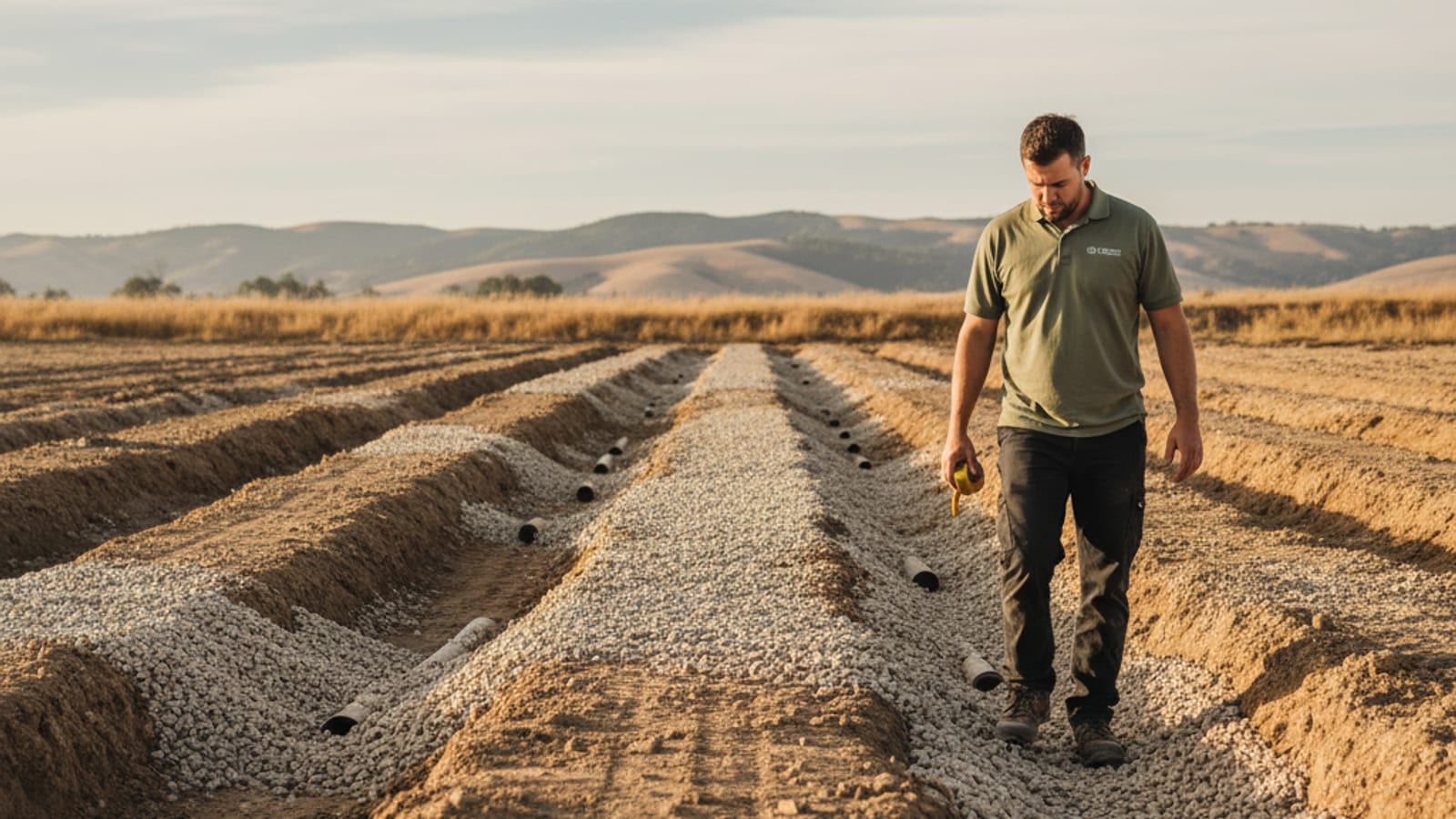
A failing drain field is the most expensive septic problem a homeowner can face. The decision between repair and replacement is the highest-stakes call in residential septic, and getting it right matters: a $2,000 jetting that buys 5 more years saves you $20,000. A $2,000 jetting on a field that needed full replacement just wastes the $2,000 and delays the inevitable.
Here’s how the diagnosis actually works, and what drives the decision toward repair or replacement.
Step 1: confirm it’s the field, not the tank
Before assuming drain field failure, rule out the simpler problem. A tank that hasn’t been pumped in 7 years can mimic field failure exactly: slow drains, surface ponding, sewage smell. Pump first, wait two weeks, see if symptoms return.
If symptoms return after pumping, the field is the real issue. If symptoms resolve and stay resolved, you had a tank problem.
Step 2: diagnose the field type and failure mode
Drain fields fail in three different ways, and each has a different repair path:
Biomat buildup. A black, slimy biological layer builds up at the soil interface in the trenches. Common in older systems with no effluent filter. Often reversible with hydro-jetting and effluent filter retrofit.
Root intrusion. Tree roots find their way into perforated leach lines and partially block them. Sometimes reversible with mechanical cutting and jetting; permanent fix requires removing the offending tree or replacing the affected lateral.
Soil exhaustion or saturation. The soil under the trenches has lost its absorption capacity, either from age or from sustained over-loading (too many people, too much water, undersized field). Generally not reversible. Full or partial replacement is the honest answer.
The pros we send diagnose the failure mode with a soil probe, surface walk, dye test, hydraulic load test, and camera inspection of the distribution box and laterals. The diagnostic itself runs $325 to $625 and almost always pays for itself by avoiding the wrong repair.
When repair is the right call
You can usually repair (rather than replace) when:
- The field is under 20 years old
- Failure is biomat or root-intrusion based, not soil exhaustion
- The distribution box is salvageable
- You can identify and fix the root cause (over-loading, missing effluent filter, root source)
Typical repair costs in San Diego County:
- Hydro-jetting and rehab: $850 to $2,400. Buys 3 to 7 years on most systems.
- Single lateral replacement: $1,800 to $4,500. Used when one trench has failed but the rest are healthy.
- Distribution box replacement: $850 to $1,800. Often combined with jetting.
- Effluent filter retrofit: $250 to $400. Should be added to any tank that doesn’t have one, since it protects the field from further damage.
- Curtain drain installation: $1,500 to $4,500. Diverts surface water away from a marginal field, often used in coastal high-water-table sites.
A combined “rehab package” (pump, jet, distribution box service, effluent filter) typically runs $2,500 to $4,500 and is the right move for a stressed-but-not-dead field on a younger system.
When replacement is the right call
Full replacement is honest when:
- Soil exhaustion is confirmed (perc test results show absorption is gone)
- The field is 30+ years old with multiple failure modes
- Previous rehab attempts have failed
- The system was undersized from day one and adding more capacity is required by current code
Replacement costs in San Diego County:
- Standard gravity field replacement: $8,000 to $15,000. Same site, similar size.
- Pressure-dosed bed replacement: $12,000 to $20,000. Used when soil class is marginal.
- Engineered Treatment Unit (ATU) system: $25,000 to $40,000. Required when perc fails or lot constraints rule out conventional fields.
- Alternative system on a constrained site: $30,000 to $55,000. Mound systems, drip systems, sand-filter systems for specific site challenges.
You’ll need a fresh perc test ($500 to $1,500) and a county DEH permit (4 to 8 weeks of timeline) for any replacement.
The middle path: partial replacement
Sometimes the right answer is replacing one or two failed laterals while keeping the rest of the field. Costs $3,500 to $9,000 and works when:
- The distribution box still distributes effluent evenly
- The unaffected laterals still pass hydraulic load testing
- The cause of the failed lateral was localized (root intrusion, single trench overload)
This is the most common honest answer for fields in the 15 to 25 year age range.
Get two quotes
For any repair-vs-replace decision over $5,000, get a second quote. Not because we don’t trust ourselves. The variance in this industry is real, and a documented second opinion gives you confidence in the decision either way.
Tank Pro SD will write a detailed diagnostic report and give you both repair and replacement numbers on every drain field call. (858) 925-5546.