If you bought an older property in San Diego County and pulled the permit history, you may have found a surprise: not a septic tank, but a cesspool. These two systems look similar on paper but work very differently, and one of them is quietly being phased out across California.
What a cesspool is vs. a septic system
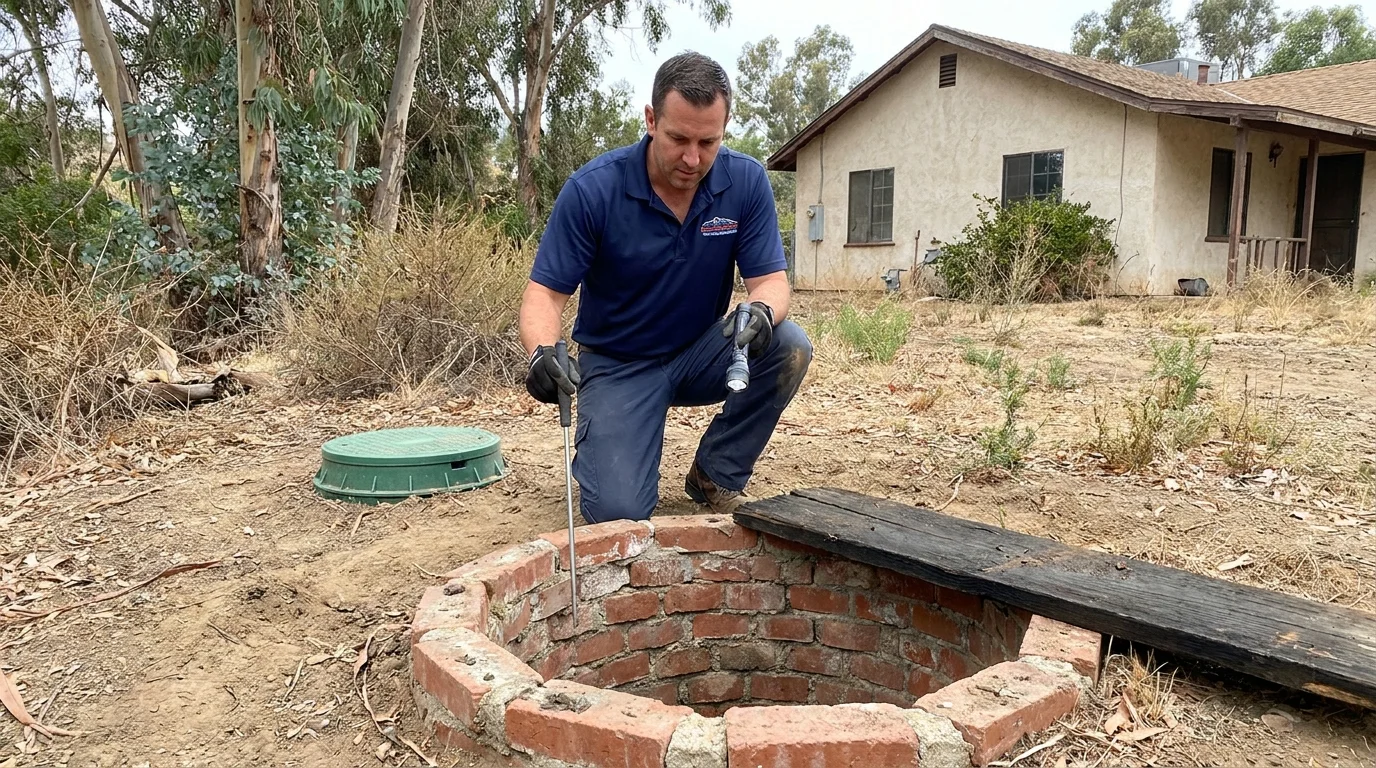
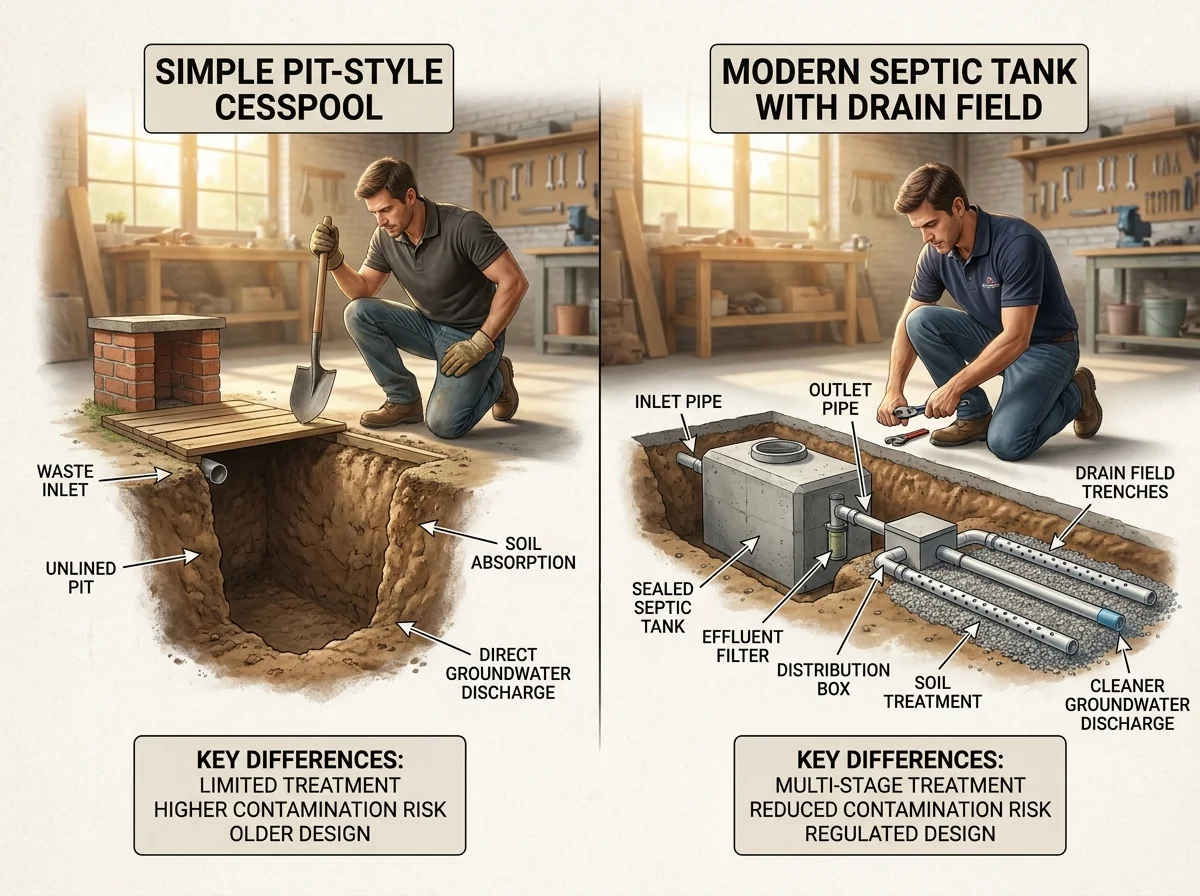
A cesspool is a buried pit, usually lined with brick, concrete block, or stone, with gaps or perforations that let liquid seep directly into the surrounding soil. There’s no treatment. Raw sewage goes in. Liquid migrates out. Solids accumulate at the bottom over time.
A modern septic system works in stages. Wastewater flows from your home into a septic tank, which is a watertight container, usually concrete or fiberglass. Inside, solids settle to the bottom and form sludge. Fats and grease float to the top as scum. The clarified liquid in the middle layer (called effluent) exits through an outlet baffle and travels to a drain field, where it’s dispersed through perforated pipes into the soil. The soil does the final treatment work.
That’s a meaningful difference. Cesspools skip the separation and treatment steps entirely. A septic system removes a large fraction of pathogens and solids before anything reaches the soil. A cesspool pushes raw sewage directly into the ground.
Older homes throughout unincorporated San Diego County, parts of El Cajon, Lakeside, Alpine, and rural areas of Ramona and Valley Center were commonly built with cesspools. At the time, it was the standard. That standard has changed.
Why cesspools are being phased out
California’s statewide OWTS (Onsite Wastewater Treatment System) Policy, administered by the California Water Boards, sets baseline standards for how septic systems must treat wastewater before it reaches groundwater. Cesspools don’t come close to meeting those standards.
Cesspools fail on two fronts. First, they have no real treatment capacity. Bacteria, nitrates, and pathogens move directly from the pit into the soil and, from there, potentially into local groundwater. In San Diego County, where many rural communities still rely on wells, that’s a real public health concern.
Second, cesspools fill up. As solids accumulate, the pit loses capacity. When it overloads, sewage can back up into the house or surface in the yard, neither of which is a minor inconvenience.
The US EPA has maintained that cesspools in certain zones pose unacceptable risk to drinking water aquifers. Some states have already mandated full phase-outs. California hasn’t done a blanket statewide ban yet, but county-level enforcement and permit rules make it very difficult to repair or expand a cesspool. If it fails, conversion is almost always required.
San Diego County’s Department of Environmental Health and Quality reviews cesspools case by case. In most scenarios, permitting a cesspool repair is no longer available. Conversion to an approved OWTS is the expected path.
Signs you have a cesspool, not a septic tank
Most homeowners don’t know which system they have until they look it up. Here’s how to tell.
Check your property’s permit history first. The San Diego County DEH Land Use Program maintains records for onsite wastewater systems. If the original permit predates the 1970s and there’s no record of a system upgrade, you may be looking at a cesspool.
Physical signs to look for on your property: a single circular access point (rather than the rectangular two-compartment lid typical of a septic tank), no visible evidence of a drain field, and older construction materials like brick or stone around the opening.
When a cesspool is failing, the signs can look similar to a failing septic system: slow drains, gurgling pipes, sewage odors near the opening or in the yard, and wet or unusually green patches in the grass above the pit. If you’re seeing any of those, you want a professional inspection before making assumptions about what’s down there.
A septic inspection by a licensed C-42 contractor can confirm whether you have a cesspool or a septic system and give you a clear picture of its current condition.
What converting to a septic system involves
Converting a cesspool to a modern septic system is a permitted construction project. It’s not a DIY task, and it’s not something a general contractor handles. In California, this work falls under the CSLB Class C-42 Sanitation System Contractor license. Verify any contractor you hire at the CSLB license check.
The conversion process typically looks like this: a site evaluation is done first, including a perc test (percolation test) to determine how well your soil handles water. The perc test results and a site plan get submitted to San Diego County DEH for permit approval. Once the permit is issued, the old cesspool is either abandoned in place (filled with clean sand or gravel) or excavated and removed, depending on site conditions and county requirements. The new septic tank is installed, the drain field is laid out and trenched, and the system is inspected before it’s covered.
For many older rural properties, the biggest variable is soil. If your soil perc rate is low, you may need a larger drain field or an alternative system such as a pressure-dosed drip field or mound system. Our post on alternative septic systems in San Diego covers those options in more detail.
One more thing worth knowing: if your property is within a zone where city sewer service is available and feasible, the county may require sewer connection instead of a new septic system. That’s a separate conversation and a very different project. See our comparison of septic vs. sewer in San Diego if you’re weighing the two.
Cost and permit considerations in San Diego
Honest answer: cesspool-to-septic conversions in San Diego County vary a lot depending on the property.
Permit fees through San Diego County DEH typically run $700-$1,500 depending on the project scope and whether the application requires additional review. That’s just the permit. Engineering or site plan preparation adds more.
The construction cost for a new septic system (tank, drain field, and installation) in San Diego County generally falls in the range of $15,000-$35,000 for a standard residential property. Challenging sites (rocky soil, steep grades, limited access, or high groundwater) push that number higher. Alternative systems with pumps and pressure dosing add cost on top of the base installation.
Abandoning the old cesspool is usually part of the quoted scope. Ask your contractor specifically whether it’s included and what method they use.
If your property is on the smaller side or has limited drain field area, the design options narrow. That’s another reason to start with a site evaluation before you get attached to a budget number. The full cost breakdown for septic system installation on this site walks through the variables in more detail.
What to do if you have an old cesspool
Start with a professional inspection. If you know you have a cesspool, or suspect you do, get it evaluated now, before it fails. A cesspool that’s actively backing up or surfacing is an emergency. A cesspool that’s still functioning gives you time to plan and budget.
Once you have an inspection report, you’ll know: current condition, estimated remaining life, whether repair is even permitted, and what a conversion would likely require on your specific site. That information is what the county will also want to see when you apply for a permit.
Don’t ignore it hoping it’ll hold. Cesspools that fail suddenly can cause significant property damage and create health hazards that the county takes seriously. Planning ahead is always cheaper than emergency response.
A new septic system installation with proper permits protects your property, keeps you in compliance, and removes the uncertainty of an aging pit that was never designed to meet modern standards.
When to call us
If you’re not sure whether you have a cesspool or a septic tank, or if you’ve confirmed a cesspool and want to understand your options, the next step is a site evaluation with someone who knows San Diego County’s permit process. Call us at (858) 925-5546 for a same-day estimate.