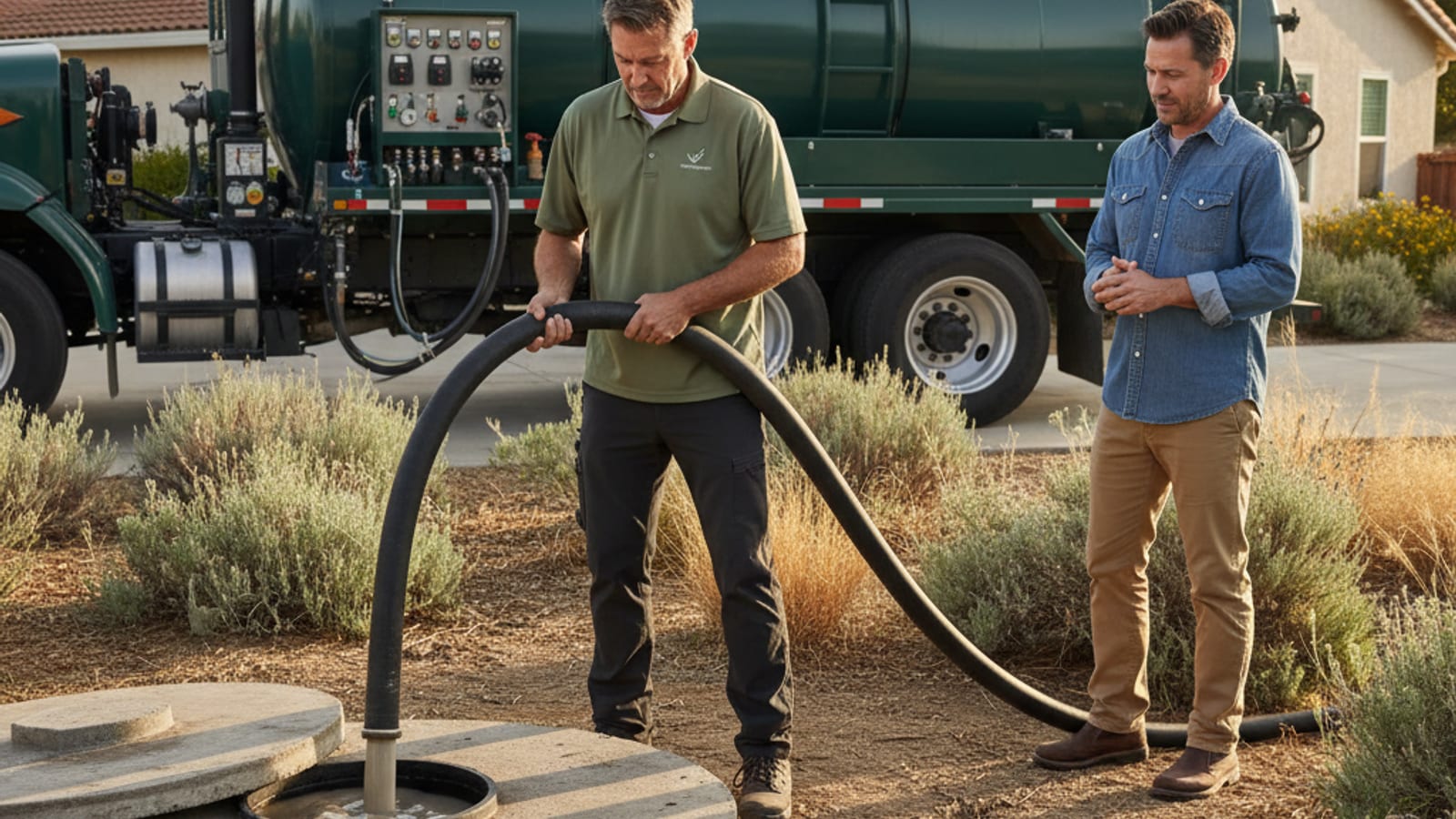
The honest answer for most San Diego County homeowners with a standard residential 1,000 to 1,500 gallon tank: $325 to $525 for a routine pump-out, scheduled within the week, with reasonable lid access. Anything dramatically lower than that should make you nervous, and anything dramatically higher needs an explanation.
This guide walks through what’s actually inside that price, what pushes it up, and which add-ons are honest value versus padding.
What’s included in a standard pump
A real residential septic pump in San Diego County should always cover:
- Full evacuation of the tank, both liquids and solids, not a partial pump that takes only the easy stuff off the top
- Sludge and scum depth measurement before and after, with a calibrated Sludge Judge
- Inlet and outlet baffle inspection
- Effluent filter cleaning, if your tank has one
- Lid and riser inspection for cracks, settling, or seal failure
- A quick visual check of the drain field surface for ponding or odor
- A written service report with measurements and your next-pump date
- County-compliant disposal at a permitted treatment facility
If a quote leaves any of those out, you’re not really comparing apples to apples.
What pushes the price up
The biggest variable is lid access. If your tank lids are at grade and easy to find, you’re paying the base rate. If we have to dig through landscaping, lift pavers, or probe to find a lid that hasn’t been opened in 15 years, expect $50 to $150 added for the dig.
Other common upcharges that are honest:
- Larger tanks. A 2,000 to 2,500 gallon tank takes more truck capacity and more time. $150 to $300 over base.
- Distance from a transfer site. Backcountry properties such as Julian, Pine Valley, and Mt. Laguna sometimes carry a small distance surcharge because the truck has to drive farther for disposal.
- Severely compacted scum or sludge. A tank that’s been neglected for 7 to 10 years can require extra time, water, and sometimes a second pass.
- Restaurant or commercial work. Grease traps and high-flow commercial systems are quoted separately from residential.
What’s worth saying yes to as an add-on
When the truck is already on site and the lid is open, several add-ons make economic sense:
Riser installation. If your lids are buried, installing a polyethylene riser stack with a bolt-down lid runs $325 to $650 per lid (less when bundled). The math: you’ll never pay another dig fee, on every pump for the next 30+ years. Pays for itself by the second pump.
Effluent filter retrofit. If your outlet baffle doesn’t have a filter cartridge, adding one runs $125 to $200. The filter traps solids that would otherwise pass into your drain field. Drain field replacement is $8,000 to $25,000. The cost-benefit is dramatic.
Baffle replacement. If the technician finds a cracked or missing baffle during the pump, replacing it on the same visit avoids a return trip charge. $250 to $650 depending on which side and what we have on the truck.
What’s not worth saying yes to
A few things to push back on:
- Mandatory bacterial additives. A healthy septic tank has all the biology it needs from normal household waste. Some accounts benefit from periodic additives (homes that use a lot of bleach, vacation homes that have sat empty), but a healthy tank doesn’t need them as a routine add-on.
- “Tank treatment” packages that don’t list specific deliverables. If you can’t read what you’re paying for, you’re paying for nothing.
- Pressure to replace a tank that just needs a baffle. This is the most common up-sell in the industry. A 25-year-old concrete tank with a broken baffle needs a $400 baffle, not a $5,000 new tank. Get a second opinion if the recommendation feels heavy.
How often should you actually pump?
Every 3 to 5 years for a typical 1,000 to 1,500 gallon tank serving a 3 to 4 person household.
Variables that push you toward the shorter end:
- More than 4 people in the home
- A garbage disposal in regular use (roughly doubles solids load)
- Heavy laundry use, multiple loads per day
- Smaller tank size (under 1,000 gallons)
Variables that push you toward the longer end:
- 1 to 2 person household
- No garbage disposal
- Larger tank (1,500+ gallons)
- Conservative water use, low-flow fixtures throughout
The most accurate answer: have a real measurement done at every pump and let the actual sludge depth set your next interval. A tank that measures 30% solids needs pumping. A tank that measures 12% solids can wait another year.
What you should walk away with
After every pump, you should have:
- A written report listing sludge and scum measurements before and after
- Photo or notes on baffle and tee condition
- A specific recommended next-pump date based on your measured fill rate, not a generic “every 3 years” sticker
- Clear notes on anything that needs follow-up (cracked lid, broken baffle, surface signs of drain field stress)
If you don’t get those, you didn’t get the full job, even if you paid the full price.
When to call us
Routine pumping in San Diego County is scheduled within a week. Emergency calls like backups and surface overflow get same-day or same-night dispatch. Call (858) 925-5546 for a real human and a real quote. No trip fees inside the county.