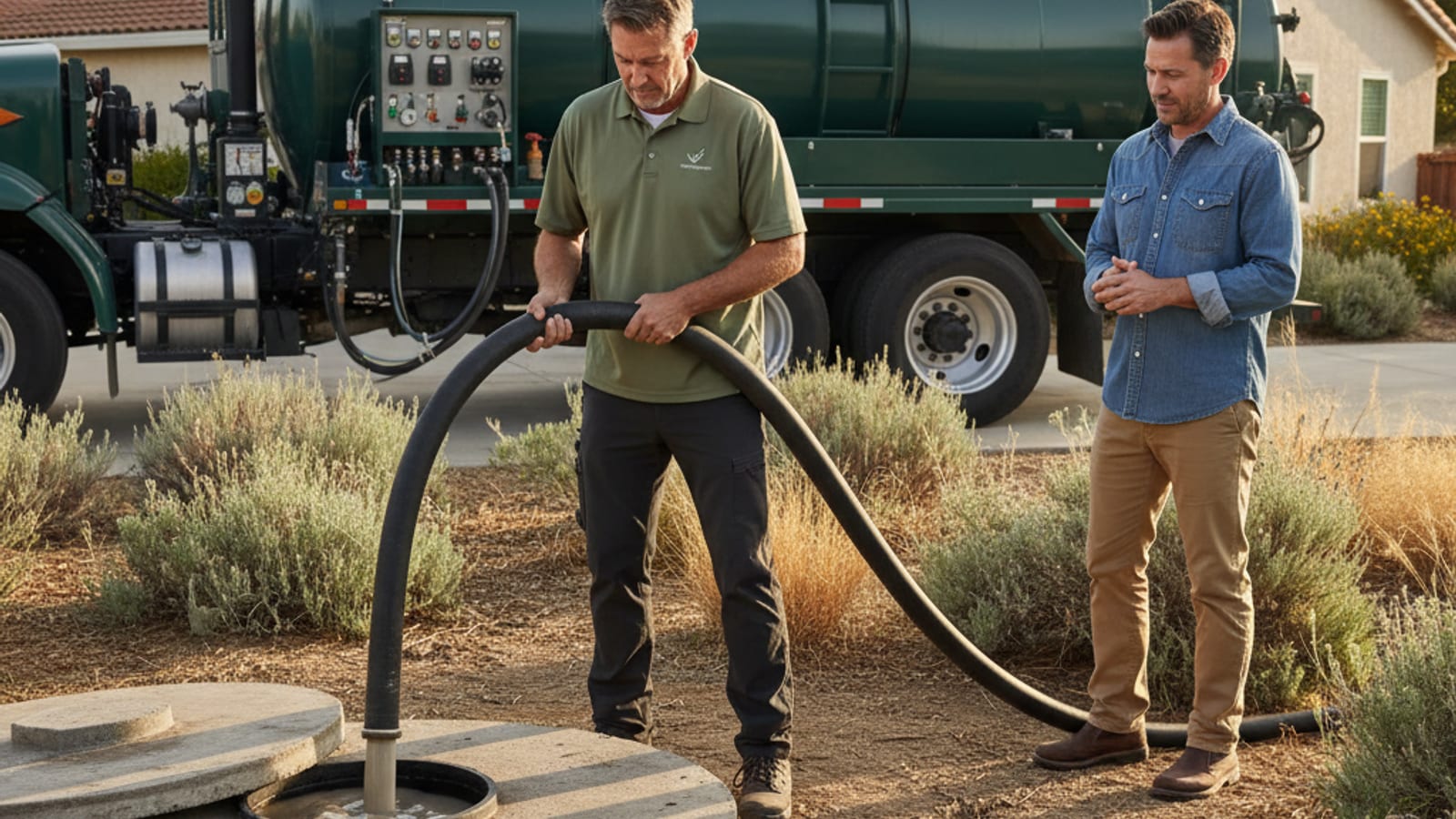
Pumping removes what flows: the liquid, the floating scum, and the loose sludge a vacuum hose can pull out. Cleaning goes further. It empties the whole tank, then rinses the hardened sludge, grease, and crust off the walls, baffles, and filter. Most San Diego County homes need a pump every 3 to 5 years. A full cleaning is for tanks that got neglected, run heavy, or are getting inspected for a sale.
That’s the short version. The longer version matters here, because soil, drought, and county rules change how often you actually need each one.
The real difference in plain terms
A standard pump-out is a fast job. The truck arrives, a tech drops the hose, and the contents get evacuated to a permitted facility. A good pump still measures sludge and scum depth, checks the baffles, and rinses the effluent filter. But it doesn’t scrub the tank.
Cleaning is pump plus pressure. After the tank is emptied, the tech rinses the interior with high-pressure water, breaks loose the compacted layer cemented to the bottom, and removes it too. Walls, baffles, and the filter housing get washed down. Then that second round of slurry gets pumped out.
Why it matters: sludge that hardens on the floor of a tank doesn’t leave with a routine pump. It builds, year over year, shrinking your working volume until solids start escaping into the drain field. A pump buys you time. A cleaning resets the tank.
Which one does your tank actually need
For most homes on a normal schedule, a pump is enough. You reach for a cleaning in specific situations.
- You skipped service for 7 to 10 years. Compacted sludge won’t lift with a plain pump. You need the rinse.
- Your tank runs heavy. Big household, a home business, frequent guests, or a casita on the same system.
- You’re selling and inspecting. A clean tank lets the inspector and pumper see baffle condition and tank integrity clearly.
- You had a backup or a drain field issue. Cleaning helps confirm whether solids carried over into the field.
- You just bought a place with unknown history. Common in San Diego backcountry, where a system may not have been touched in years.
If none of those fit and you’ve kept a regular schedule, save the money and pump.
What it costs in San Diego County
National averages run low for our area. San Diego County labor, fuel, and the drive to a permitted transfer site push real local pricing above the numbers you’ll see on national cost sites. Here’s the honest range for a standard residential tank.
| Service | What you get | San Diego County range |
|---|---|---|
| Routine pump-out | Full evacuation, baffle check, filter rinse, sludge measurement | $325 to $525 |
| Full cleaning | Pump plus high-pressure rinse, hardened-sludge removal, wall and baffle wash | $525 to $850 |
| Backcountry surcharge | Added drive time to a permitted site (Julian, Pine Valley, Mt. Laguna) | $50 to $150 |
| Hard lid access | Digging through landscaping or pavers to reach a buried lid | $50 to $150 |
A cleaning costs more because it takes more time, more water, and a second pump pass. If a company quotes a “cleaning” at the same price as a pump, ask exactly what the rinse step includes. For a deeper breakdown of pump pricing, see our septic pumping cost guide for San Diego County.
How San Diego conditions change the math
This is where national guides go quiet. Local conditions move your schedule.
Backcountry and East County soil. Julian, Ramona, Alpine, Jamul, Valley Center, Fallbrook, and Pine Valley sit on a mix of decomposed granite and expansive clay. Tight clay soil drains slowly, so the tank works harder and sludge can build faster. A home in Jamul on heavy soil may need service sooner than the same household near sandier ground.
Drought and low water use. When households cut water during dry years, less liquid moves through the tank. That sounds good, but lower flow can let solids settle and compact harder. Conserving water is right. Just don’t assume a long-dry year means you can stretch your pump interval.
Groundwater and the drain field. Seasonal groundwater in low-lying areas can flood a drain field and back pressure into the tank. If your field already struggles, a clean tank is one less variable. When the field itself is the problem, pumping won’t fix it. See our guide on drain field repair vs replacement.
County DEH rules. San Diego County’s Department of Environmental Health and Quality (DEHQ) regulates onsite wastewater treatment systems (OWTS). Permits, percolation tests, and inspection records come into play for new systems, repairs, and many property sales. A documented pump or cleaning history helps when DEHQ wants proof a system is sound.
How often, realistically
The EPA’s rule of thumb is a pump every 3 to 5 years and an inspection at least every 3. That’s a fine baseline. Adjust it for your reality.
- Small household, normal use, good soil: every 4 to 5 years.
- Family of four to five, average use: every 3 years.
- Large household, home business, or a casita on the system: every 2 to 3 years.
- Backcountry tight-clay soil or a stressed drain field: lean toward the shorter end.
You earn a full cleaning when the tank has been ignored long enough that routine pumping no longer keeps up. Regular pumping is what keeps you out of cleaning territory in the first place.
Frequently asked questions
Is septic cleaning the same as pumping? No. Pumping removes the liquid and loose sludge. Cleaning empties the tank, then rinses and removes the hardened layer stuck to the walls and floor. Cleaning includes pumping, but pumping doesn’t include the rinse.
Do I need cleaning if I pump on schedule? Usually not. Consistent pumping keeps sludge from compacting, so most well-maintained tanks never need a full cleaning. Cleaning is the catch-up move for neglected or heavy-use systems.
How much more does cleaning cost than pumping in San Diego? Plan on roughly $200 to $350 more than a routine pump, because of the added rinse step and second pump pass. Backcountry drive time can add more.
Does drought change how often I should pump? It can. Lower water use means solids settle and compact harder, so don’t assume a dry year lets you skip service. Keep your normal schedule.
Does San Diego County require proof of pumping? For new permits, repairs, and many property sales, the county DEHQ looks at OWTS records. A documented service history makes those steps smoother.
Can I tell which one I need without opening the tank? Not reliably. A tech measures sludge and scum depth during service and tells you whether a pump cleared it or whether the tank needs the full rinse. That measurement is the honest answer.
Not sure which one your tank needs
We’ll measure your sludge and scum depth, tell you straight whether a pump clears it or the tank needs a full cleaning, and give you an upfront quote before any work starts. We cover all of San Diego County, including the backcountry, and we know the local DEHQ rules. Compare our septic pumping service and septic tank cleaning service, or just call and tell us what’s going on.
Call Tank Pro SD at (858) 925-5546 for an honest read on your system.