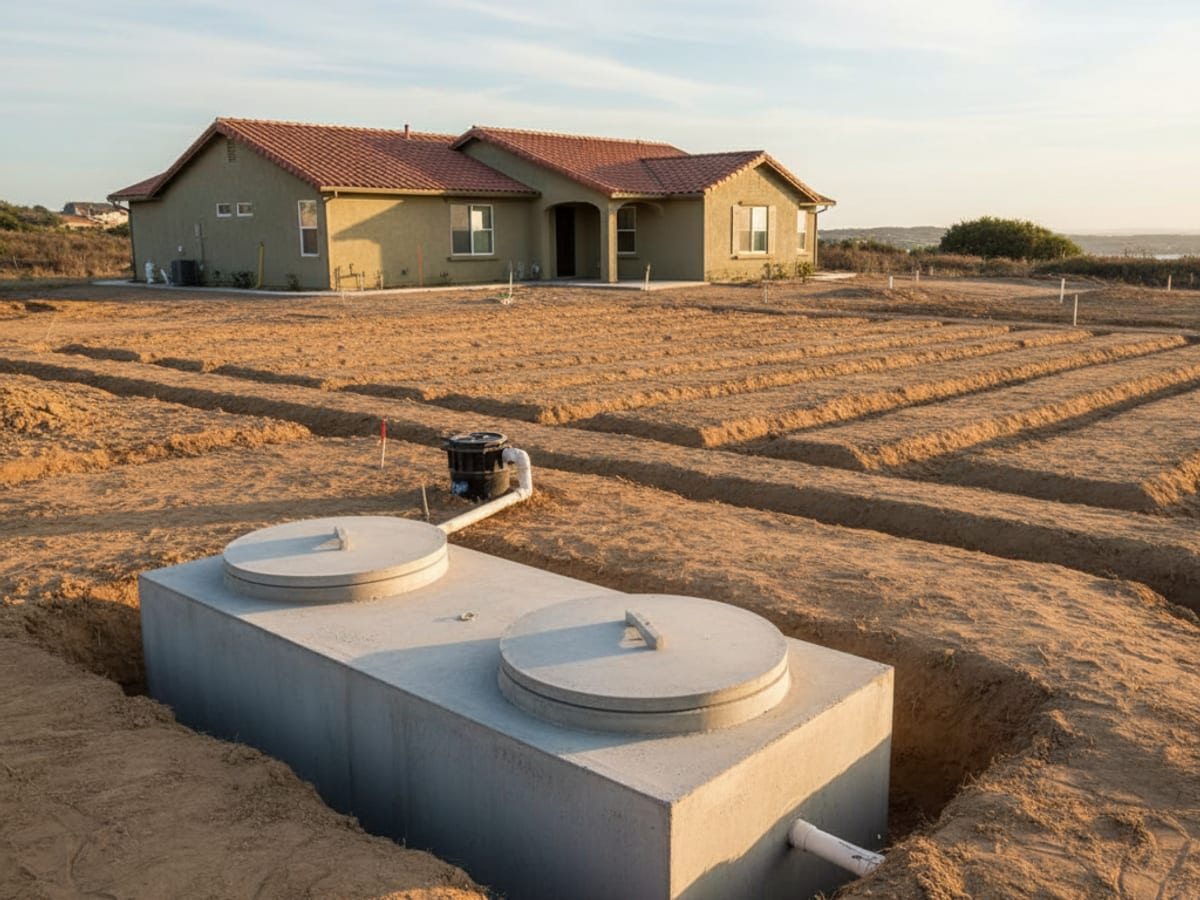
A septic permit in San Diego County runs through the Department of Environmental Health and Quality (DEHQ), Land and Water Quality Division. You need one for any new system, tank replacement, or drain field repair. Budget roughly $2,500 for layout and permit on a typical home, plus around $3,500 if a percolation test is required. Here’s how the process actually works.
Who issues septic permits in San Diego County
The permitting agency is the county DEHQ, not the city and not the building department alone. Their Land and Water Quality Division reviews septic plans, approves the layout, and inspects the finished work.
San Diego County runs its program under a Local Agency Management Program, or LAMP. The current LAMP took effect February 1, 2025. It sets the rules for onsite wastewater treatment systems, which the county calls OWTS. If you have a septic system, you’re operating under the LAMP.
This matters most in the backcountry. Areas like Julian, Ramona, Alpine, Jamul, Valley Center, Fallbrook, and Pine Valley sit outside sewer service. Septic is the only option, so nearly every project out there touches DEHQ.
When you need a septic permit
You need a county Installation Permit for more than just new construction. Under the LAMP, the following all require a permit and a DEHQ inspection:
- New system install on a vacant lot, ADU, or new build
- Tank replacement, swapping a cracked, collapsed, or rusted-through tank
- Repair that modifies or replaces the dispersal system, the tank, or a major component
- Replacement OWTS, meaning expanded treatment capacity or a new or added drain field
Routine pumping and cleaning don’t need a permit. The line is structural. If the work changes the tank or the drain field, it’s permitted. If it just empties the tank, it isn’t.
The permit process, step by step
Here’s the real order of operations in San Diego County.
- Soil and percolation testing. A site evaluation and perc test establish how fast the soil drains. This drives the entire system design.
- Layout and design. A licensed professional designs the system and submits the layout to DEHQ for approval.
- Layout approval. DEHQ reviews and approves the layout. This approval is valid for one year.
- Permit issuance. For new construction, DEHQ issues the septic permit alongside the building permit, often the same day.
- Install. The system goes in once the permit is in hand.
- DEHQ inspection. County staff inspect before backfill. This is required, not optional.
- Close-out. The permit closes after a passing inspection.
One quirk worth knowing: on new construction, the county won’t issue the septic permit until you have a building permit. The two typically issue together.
Percolation testing rules
This is where San Diego County is stricter than the generic advice you’ll find online, and where backcountry lots get expensive.
All percolation testing for dispersal systems, except vertical seepage pits, must be done by or under the direct supervision of a California registered professional engineer, geologist, or qualified OWTS professional. You can’t dig a hole, pour water in, and call it a perc test here. The county wants a credentialed professional signing off.
Two timing facts that save people money:
- Layout and perc design approval expires after one year. If your project stalls, the approval lapses.
- The soil test data itself does not expire. Even if the design approval lapses, the actual perc data stays valid for future design, as long as site conditions haven’t changed.
So if you tested a lot two years ago and never built, you may not need to re-test. You may only need a fresh design. That’s a meaningful saving.
What a septic permit costs in San Diego County
Costs vary by lot, soil, and system type. Here’s a realistic 2026 breakdown for the county, with national figures for comparison so you can see why local numbers run higher.
| Item | San Diego County | National range |
|---|---|---|
| Layout + permit (typical 2,200 sq ft home) | ~$2,500 | $200–$500 permit only |
| Percolation test (required) | ~$3,500 | $750–$1,850 |
| Soil scientist / engineer sign-off | included in test | $200–$500 add-on |
| Operating permit (supplemental treatment) | annual | varies |
The national permit-only figure of $200 to $500 is misleading for our area. In San Diego County, the layout and permit package for a typical home lands closer to $2,500 because it bundles the professional design DEHQ requires.
The perc test is the big variable. Expect roughly $3,500 on many county lots. Here’s a backcountry tip: if your lot has no prior percolation data, the county may apply the worst-case rate from neighboring lots and waive the perc test fee entirely. Rocky or steep lots in East County can also push testing cost up because they need machine-dug holes.
Supplemental treatment and operating permits
Marginal soil, a high water table, or environmentally sensitive ground often means a standard system won’t pass. The fix is a supplemental treatment system, which adds an advanced treatment unit before the drain field.
These carry ongoing obligations the county tracks. Supplemental treatment systems require percolation testing, a design from a licensed OWTS professional, and an annual operating permit with biannual inspections by a qualified service provider. Plan for that recurring cost if your lot needs advanced treatment. It’s common on tight backcountry parcels.
Why permitting is non-negotiable
Two reasons skipping the permit costs more than it saves.
Resale. Real-estate inspections check for permitted septic work. Unpermitted installs become a buyer-side disclosure problem and stall or kill escrows. Re-permitting after the fact costs more than doing it right up front. Our real-estate septic inspection guide walks through what buyers and sellers run into.
Liability. A claim tied to an unpermitted system can be denied. The fee difference between permitted and unpermitted work is small. The difference at claim time is not. Any reputable C-42 contractor won’t do unpermitted septic work, and a contractor who offers to skip the permit is one to walk away from.
How long the whole thing takes
The dig is fast. The county review is the slow part.
- Soil and perc testing: 1 to 3 weeks to schedule and complete
- Layout and design submittal: a few days once testing is done
- DEHQ plan review: 2 to 4 weeks, longer in summer
- Install: 1 to 2 days
- Final inspection and close-out: within 1 to 2 weeks of install
Total, from first call to closed permit, usually 4 to 10 weeks. Backcountry lots with new perc testing sit at the longer end. For cost specifics once the permit clears, see our septic tank installation cost guide.
Frequently asked questions
Do I need a permit to replace just my septic tank? Yes. Replacing a tank is a repair under the county LAMP, which requires a DEHQ Installation Permit and an inspection before backfill.
How much is a septic permit in San Diego County? For a typical home, budget around $2,500 for the layout and permit package. A required percolation test adds roughly $3,500, though the county may waive the test fee on lots with no prior data.
Does my old percolation test still count? The design approval expires after one year, but the soil test data itself does not expire. If site conditions haven’t changed, your old perc data may still be usable for a new design.
Can I pull a septic permit before my building permit? On new construction, no. The county issues the septic permit alongside the building permit, usually the same day.
Who has to do the percolation test? A California registered engineer, geologist, or qualified OWTS professional must perform it or directly supervise it. Homeowner-dug tests don’t qualify.
Do backcountry lots need anything extra? Often yes. Lots in Julian, Ramona, Alpine, and similar areas with marginal soil may need a supplemental treatment system, which carries an annual operating permit and biannual inspections.
Get a real quote with the permit included
Tank Pro SD handles septic installs, replacements, and repairs across San Diego County, including the East County backcountry, fully permitted through DEHQ. We quote the permit, design, and install up front, with no surprise line items. For a new or replacement system, see our septic system installation service. To talk through your lot and what the county will require, call (858) 925-5546.