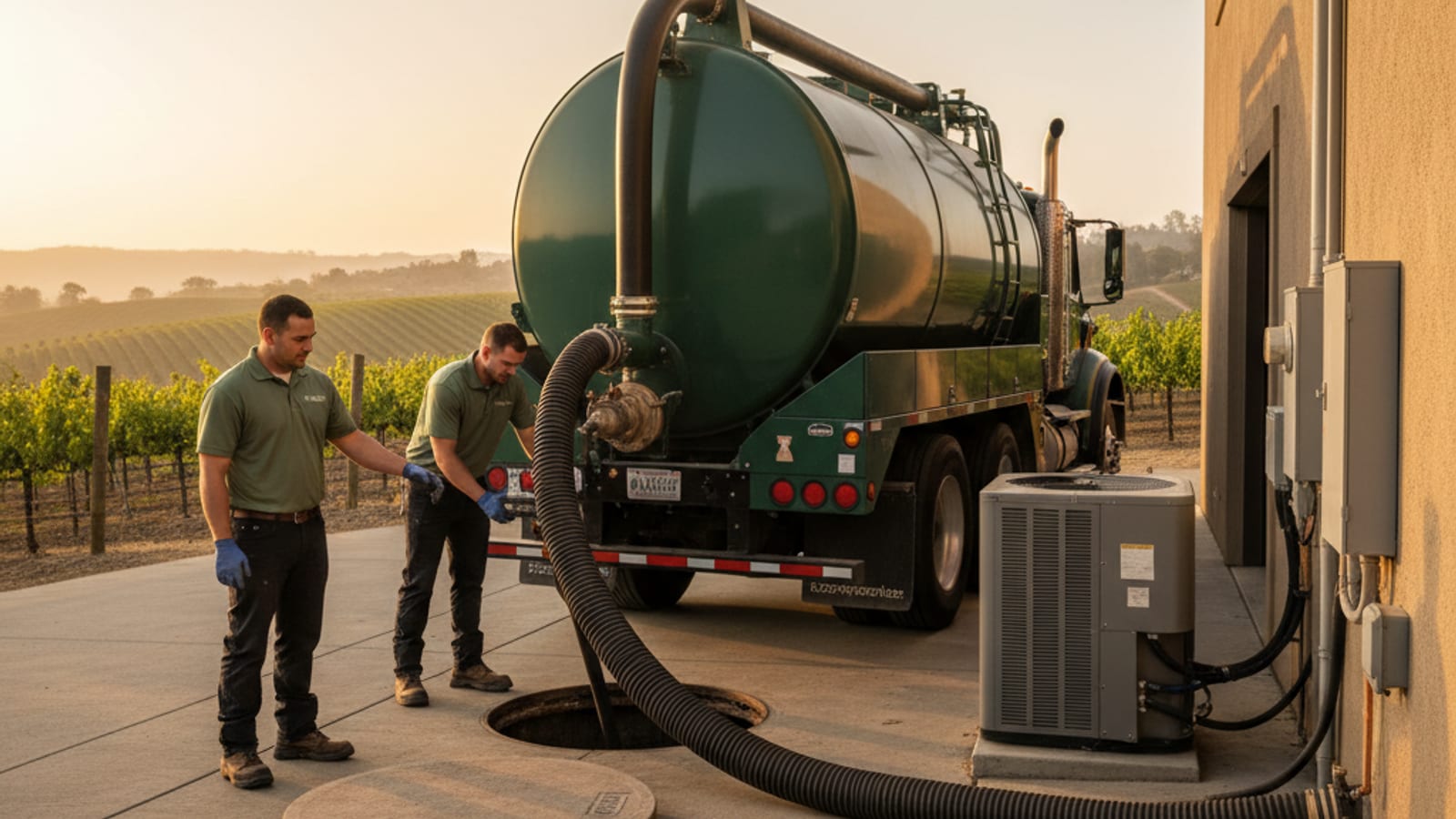
Commercial septic in San Diego County is its own world. Bigger tanks, higher daily flow, grease loads, multi-tank configurations, and downtime that costs real revenue. Different rules, different equipment, different scheduling.
Here’s what commercial operators in SD County need to know about service intervals, contract structure, and how to keep the operation running without a daytime shutdown.
What makes commercial different
Three structural differences from residential:
1. Tank size. Residential systems run 1,000-1,500 gallons. Commercial systems start at 1,500 gallons and run to 15,000+ gallons for high-flow operations. Pumping a commercial tank requires bigger trucks, more disposal capacity, and more time on site.
2. Flow patterns. Residential flow is even, 200-400 gallons per day, spread across the week. Commercial flow concentrates: a restaurant pushes most of its daily volume across a 4-hour service window. A winery pushes most of its annual volume in 6-week harvest crush. Service intervals have to account for these spikes, not just average flow.
3. Grease, oil, and food solids. Restaurants, breweries, and food-service operations send much higher concentrations of fats, oils, and grease (FOG) into the system than residential. Most commercial food-service operations require a dedicated grease trap upstream of the septic tank, and both need separate service intervals.
Common commercial septic operations in SD County
The verticals we see most:
Restaurants and food service. Tank sizes typically 2,000-5,000 gallons plus a 500-1,500 gallon grease trap. Service interval driven by FOG load, often weekly to monthly on the grease trap, every 6-18 months on the main tank.
Wineries and tasting rooms. Tanks 3,000-8,000 gallons. Service interval is seasonal: heavy crush-season pumping (Aug-Oct), lighter rest-of-year. Some operations need a dedicated process-water system separate from sanitary septic.
Ranches and equestrian properties. Multi-residence systems for ranch hands plus barn-area systems. Tanks 1,500-5,000 gallons each. Service driven by occupancy.
HOAs and small communities. Multi-residence shared systems for small unincorporated communities. Tanks 5,000-15,000 gallons, often multiple tanks. Annual service contracts with documented inspections for HOA boards.
Mobile-home and RV parks. Multi-residence systems with high seasonal variability. Annual service contracts standard.
Schools and childcare facilities. 1,500-3,000 gallon tanks with steady weekday flow. Quarterly inspection + annual or biannual pump common.
Camp grounds, retreat centers, event venues. Highly seasonal. Shoulder-season service, pre-season prep visit, post-season check.
What it costs
Commercial work is quoted per site rather than off a residential price sheet. Approximate ranges in SD County:
- Commercial pump (2,000-5,000 gal tank): $475 to $1,200 per visit
- Commercial pump (5,000-10,000 gal): $1,200 to $2,800
- Grease trap service (500-1,500 gal): $325 to $750
- Annual recurring contract (typical restaurant): $2,400 to $6,000/year
- Annual recurring contract (winery, mid-size HOA): $3,000 to $12,000/year
- One-time inspection for sale or refinance: $850 to $2,400 depending on system size
Recurring contracts are typically 10-30% cheaper per visit than ad-hoc service, plus they include night and weekend pumping at no after-hours surcharge.
Why night and weekend pumping matters
For most commercial operators, the biggest hidden cost of septic service isn’t the pump price. It’s the operational disruption.
A restaurant that has to stop service for a 3-hour pump in the middle of dinner loses far more than the cost of the pump itself. We schedule restaurant pumps between midnight and 6am to avoid the impact.
Same logic for wineries during crush, retail centers during weekend traffic, and event venues during booked weekends. Off-hours scheduling is part of what you’re paying for in a real commercial contract.
What documentation you should expect
Commercial septic operators get more documentation than residential, because more parties care:
- Written service report after every visit, including measurements, observations, and disposal documentation
- Annual summary report for insurance, county DEH, and (where relevant) liquor licensing files
- Compliance documentation covering disposal at permitted treatment facilities, with signed manifests
- Inspection reports for any sale, refinance, or insurance event
If your current commercial provider doesn’t deliver these, you’re missing protection that’s already built into your fee.
Switching providers
We do 4-5 commercial provider transitions a year in SD County. The process:
- Bring us your last 12 months of service records. We baseline what was done and identify any gaps.
- Site walk. We map every tank, grease trap, and access point on the property.
- Proposal. We quote a service plan typically 10-30% cheaper than incumbent, with clear deliverables and documentation standards.
- Transition visit. Initial baseline inspection and any catch-up service the system needs.
No long-term contracts required. Most transitions happen because the operator stopped getting written reports, missed scheduled visits, or refused to do off-hours work. Those problems are solvable.
ATU and pressure-dosed systems
Many commercial operations now run on Aerobic Treatment Units (ATUs) or pressure-dosed systems for higher treatment quality and to qualify for tighter setbacks. These need:
- Routine air-pump and effluent-pump checks (quarterly minimum)
- Sludge and scum measurement (semi-annual or annual)
- Component replacement on a depreciation schedule (pump impellers, blower diaphragms, UV bulbs)
- County-required permit reporting (some systems require quarterly or annual sampling)
Commercial ATU contracts run higher than gravity-system contracts ($3,000-$8,000/year for typical small commercial) but the system itself is mandatory on many newer installs.
Schedule
Tank Pro SD covers commercial septic across San Diego County: restaurants, breweries, wineries, ranches, mobile-home parks, schools, camps, and HOAs. (858) 925-5546 for a site walk and proposal.