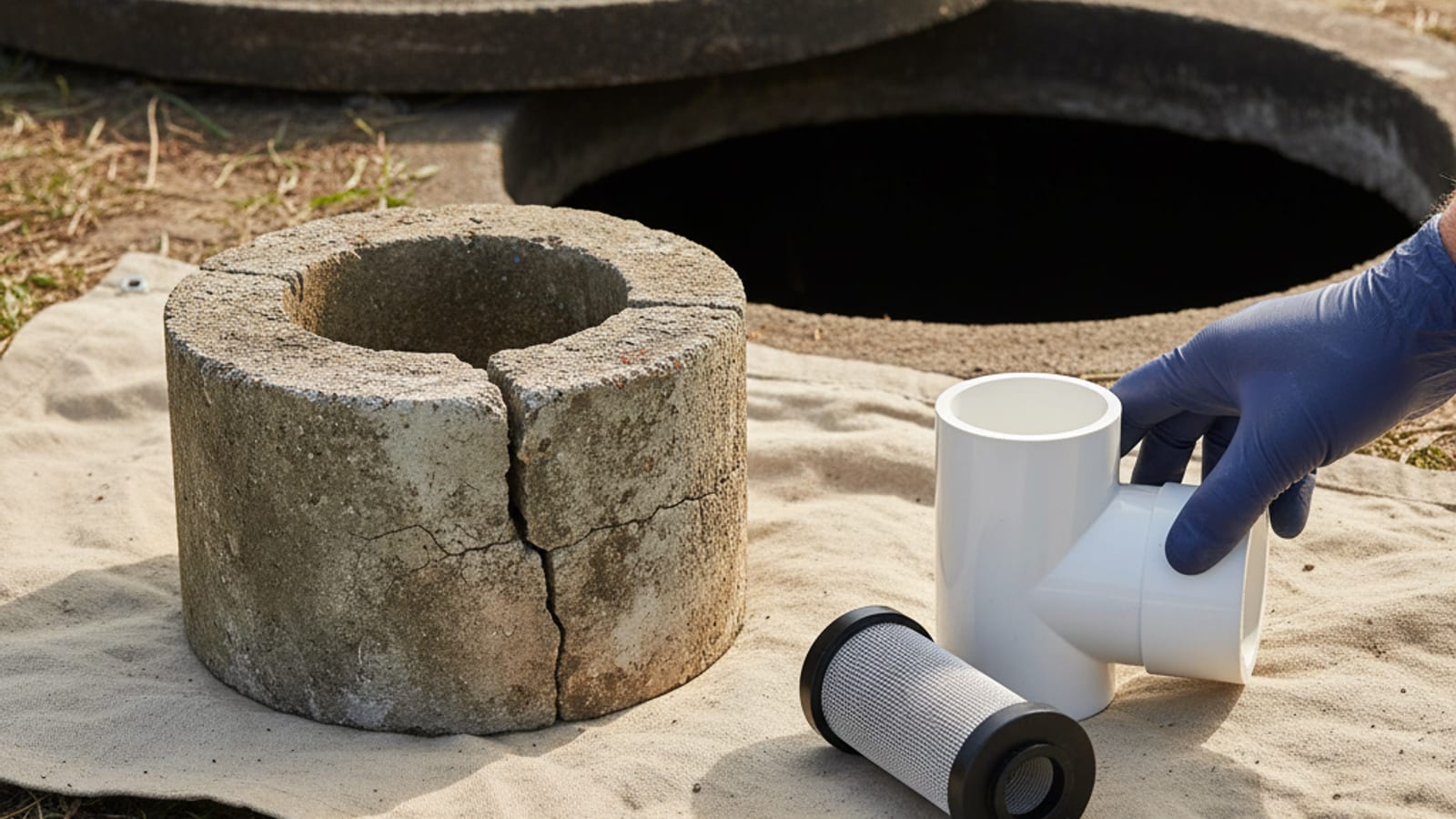
Baffles are the unsung heroes of a septic tank. Most homeowners never think about them. But when one fails, the entire drain field is at risk, and drain field replacement is the most expensive residential septic problem you can have.
Here’s what baffles do, why they fail, and why replacing them is often the highest-ROI septic repair you can make.
What baffles do
A standard residential septic tank has two baffles, inlet and outlet, and they have very different jobs.
The inlet baffle sits where waste enters the tank from the house. It directs incoming flow downward, slowing it and giving solids time to settle out instead of ricocheting straight across the tank toward the outlet.
The outlet baffle sits where treated effluent exits the tank toward the drain field. It draws effluent from the middle of the liquid layer, below the floating scum and above the settled sludge. This is the cleanest portion of the tank’s contents, and it’s what should reach the drain field.
If either baffle fails, the system loses its ability to separate solids from liquid. Solids start flowing toward the drain field. The drain field clogs. Drain field replacement runs $8,000 to $25,000.
How baffles fail
Original concrete baffles fail in three ways:
Corrosion. Hydrogen sulfide gas in the tank attacks concrete over time. Concrete baffles installed in the 1970s and 1980s often show significant degradation by their 25-30 year mark. Surface pitting progresses to structural cracking, eventually breaking off entirely.
Mechanical damage from pumping. The vacuum hose used during routine pumping is heavy and inflexible. A careless pump operator can crack a brittle baffle on contact. This is why we’re careful about hose handling on every job.
Settlement and shifting. Tanks settle over decades, and baffles bonded to the tank wall can crack along the bonding line.
PVC sanitary tees (modern replacement baffles) fail much less often. They’re flexible enough to absorb mechanical impact and chemically resistant to tank atmosphere.
How we know a baffle has failed
Several clear signs:
- Visual inspection during a pump, showing broken-off concrete pieces at the bottom of the tank, missing baffle material, or a cracked tee
- Solids visible in the outlet line during a camera inspection
- Solids in the distribution box at the start of the drain field
- Effluent breakthrough at the drain field surface (late-stage indicator)
- Backups that return within weeks of pumping, because solids keep reaching the field even after the tank is emptied
A real septic inspection always checks both baffles with a flashlight and a camera. Visual confirmation is straightforward.
Replacement, not repair
For most failed baffles, the right answer is to replace with a modern PVC sanitary tee, not to attempt to patch the original concrete.
Reasons:
- PVC tees are sturdier, lighter, longer-lasting
- They’re easier to size correctly
- They accept effluent filter retrofits without modification
- Concrete patches usually fail again within a few years
Concrete baffles with very minor surface damage on a young tank can sometimes be epoxy-patched, but this is the exception, not the rule.
What it costs in San Diego County
In 2026:
- Single baffle replacement (inlet or outlet): $250 to $650
- Pair of baffles: $450 to $1,000
- Effluent filter add at the same visit: $125 to $200
- Bundled with a routine pump: typically $150-$300 less than standalone
Total cost for a complete pump + baffle replacement + effluent filter retrofit on an older tank typically runs $850 to $1,500. That’s the highest-ROI septic maintenance bundle on a tank in the 20-30 year age range.
Effluent filters: the modern upgrade
Most modern septic tanks include an effluent filter cartridge installed in the outlet baffle. The filter traps solids that would otherwise pass into the drain field, adding a second layer of protection beyond what the baffle alone provides.
If your tank doesn’t have one, the answer is almost always to add one. They cost $125-$200 retrofitted, need cleaning every 1-3 years (we do it during routine pumps), and dramatically extend drain field life.
The pros we send retrofit an effluent filter on roughly 80% of the older tanks they service. The math is unforgiving in the filter’s favor.
When to replace versus when to monitor
Clear-failure baffles need replacement immediately. Marginal-condition baffles (visible cracking but still structurally intact) can sometimes be monitored for 1-2 service intervals, but plan and budget for replacement at the next pump.
Don’t wait for full failure. The cost difference between proactive replacement and reactive replacement-after-field-damage is enormous.
Schedule
Tank Pro SD does baffle and tee replacement across San Diego County as standalone work or bundled with routine pumping. (858) 925-5546.